
Turning Complexity into Capability: Canada’s Defence Procurement System for Major Projects
June 18, 2026
Summary
Canada’s defence procurement system is at a pivotal moment. Against a backdrop of heightened geopolitical instability, accelerated technological change, and unprecedented increases in defence spending, the Government of Canada has launched significant reforms to address longstanding challenges in how major defence capabilities are acquired, sustained, and delivered. This report, Turning Complexity into Capability: Canada’s Defence Procurement System for Major Projects, is both timely and necessary. It provides an independent, system level overview of Canada’s defence procurement framework at the precise moment when foundational changes—most notably the introduction of the new Defence Industrial Strategy and creation of the Defence Investment Agency and—are beginning to reshape the landscape.
The importance of this study lies in its main focus on major defence projects, which represent the highest risk, highest value procurements undertaken by the federal government and are critical to the operational readiness of the Canadian Armed Forces. Persistent delays, cost growth, fragmented accountability and complexity have constrained Canada’s ability to deliver timely capability, undermining national defence objectives and public confidence. As reforms move from policy intent to implementation, a clear understanding of how the existing system operates—and its major challenges—is essential to ensure change efforts are informed, coherent, and sustainable.
The report is presented in two complementary volumes, each serving a distinct but interconnected purpose.
- Volume 1 provides a clear, structured overview of Canada’s defence procurement system for major projects. It maps the rules, authorities, institutions, and processes that govern defence procurement end to end, translating a highly complex system into an accessible reference that establishes a common understanding of how the system has operated. This baseline is critical as Canada transitions away from its legacy framework and implements new reforms.
- Volume 2 builds on this foundation by examining the system’s most pressing challenges and identifying opportunities to strengthen defence procurement outcomes going forward. Drawing on expert consultations and analysis, it highlights persistent issues, including fragmented accountability, risk averse decision making, weak data and performance measurement, gaps in contract administration, and misalignment between industrial policy and procurement execution. Importantly, Volume 2 sets out practical considerations to support informed decision making as Canada defines its future defence procurement model.
Together, the two volumes aim to support informed decision making, promote transparency, and contribute to constructive dialogue at a critical juncture for Canada’s defence procurement system—as Canada is positioned to turn complexity into capability through meaningful, lasting reform.
Office of the Procurement Ombud
The Office of the Procurement Ombud (OPO) is a neutral and independent organization of the Government of Canada that works collaboratively with federal departments and Canadian businesses (suppliers) to promote fairness, openness, and transparency in federal procurement. OPO delivers on this mandate by connecting stakeholders, investigating complaints, resolving problems, making recommendations, and sharing best practices.
In 2018, OPO launched a knowledge deepening and sharing (KDS) initiative to better understand key issues in federal procurement. Through the publication of KDS studies, OPO intends to share knowledge and provide meaningful guidance for federal procurement stakeholders.
Acknowledgements
OPO would like to thank all stakeholders who played a crucial role in informing this study, most notably the defence procurement experts who provided valuable feedback during the interview process.
Enquiries
- Enquiries should be directed to:
- Office of the Procurement Ombud
410 Laurier Ave. W., Suite 400
Ottawa, Ontario K1R 1B7
Canada - Telephone:
- 1-866-734-5169
- Toll-free for hearing-impaired:
- 1-800-926-9105
- Email:
- ombudsman@opo-boa.gc.ca
- Cat. No.:
- P114-49/2026E-PDF
- ISBN:
- 978-0-662-35513-7
On this page
- Purpose of the study
- Introduction
- Methodology
- Volume 1: Overview of Canada’s defence procurement system for major projects
- Canada’s defence and security context
- Rules governing procurement execution for Canadian major defence projects
- Key government actors in the Canadian defence procurement system
- The defence procurement process for major projects
- Reforms laying the foundation for change: the Defence Investment Agency and the Defence Industrial Strategy
- Volume 1: Conclusion
- Volume 2: Defence procurement challenges and considerations in the context of ongoing reform
- Reducing complexity in a procurement system constrained by fragmented accountability and data gaps
- Ensuring defence contracts deliver results for Canada
- Advancing industry collaboration and a transparent procurement pipeline
- Building professionalization and culture in the defence procurement workforce
- Improving institutional coordination and readiness in defence procurement
- Volume 2: Conclusion and considerations
Purpose of the study
The purpose of this study is to provide the defence procurement community with meaningful insights as Canada implements significant reforms and transitions away from its legacy defence procurement system for acquiring major defence capabilities.
This report is presented in 2 volumes. Volume 1 provides a high-level, structured overview of Canada’s current defence procurement system for major projects, including the relevant policies and partnerships, applicable rules and authorities, key government actors, and the overarching end-to-end process. Volume 1 concludes with an overview of the most significant reforms to the defence procurement system, notably the establishment of the 2025 Defence Investment Agency and the release of the 2026 Defence Industrial Strategy.
Volume 2 identifies and analyzes key challenge areas and opportunities for further consideration as Canada seeks to adapt and modernize its future defence procurement framework.
For the purposes of this study, major defence projects refers to the acquisition and sustainment of large, high-risk, high-complexity defence capabilities managed through formal project management and exceed departmental delegated authorities under Treasury Board project complexity and risk frameworks.Footnote 1
Introduction
Defence procurement is essential to Canada’s national security and military readiness. It is how the Government of Canada builds, sustains, and modernizes the capabilities that the Canadian Armed Forces need to operate at home and abroad. This involves not only purchasing equipment, but also the long‑term support, services, and infrastructure required to stand up and sustain these capabilities.
Defence procurement also serves broader national goals—supporting industry, fostering innovation, and strengthening interoperability with partners. Yet, it has long been criticized as slow, complex, and fragmented, challenges that are increasingly pressing in today’s rapidly evolving security environment.
Recognizing this, the Government of Canada has launched significant reforms, including integrating the Canadian Coast Guard under the Department of National Defence,Footnote 2 creating the Defence Investment Agency to accelerate major procurements,Footnote 3 and releasing a new Defence Industrial Strategy to strengthen sovereignty and resilience.Footnote 4
Foundational changes to the system are in their initial stages, and significant work remains to transform defence procurement into a system that consistently delivers what Canada needs.
Methodology
The content of this report was developed through research conducted by the Office of the Procurement Ombud (OPO) using using multiple sources, including:
- Structured interviews with ten (10) defence procurement experts across government, industry, and academia;
- Feedback and insights received from the broader federal defence procurement community over the past three (3) years; and
- Review of primarily publicly available information, including Government of Canada publications and other relevant sources. Certain observations in the report could be impacted by the existence of internal departmental instruments that are not publicly available.
Volume 1: Overview of Canada’s defence procurement system for major projects
Volume 1 of this report provides an overview of Canada’s defence procurement system for major projects, beginning with key elements of Canada’s defence and security context. This is followed by a review of the procurement rules, the roles of key federal actors, and the end‑to‑end legacy procurement process, before concluding with an overview of system reforms, notably the establishment of the Defence Investment Agency and the release of the 2026 Defence Industrial Strategy.
Canada’s defence and security context
To understand how Canada’s defence procurement system operates, it is first necessary to consider the defence policies, initiatives, and international partnerships that shape the strategic demands, capability objectives, and commitments the system is designed to deliver.
Strong, Secure, Engaged and Our North Strong and Free
Canada’s 2017 defence policy, Strong, Secure, Engaged: Canada’s Defence Policy (SSE), established a 20‑year plan to rebuild and modernize the Canadian Armed Forces (CAF) based on a vision of being strong at home, secure in North America, and engaged in the world. It sought to improve readiness, expand force capacity, and address long‑standing equipment gaps while supporting continental and allied commitments through North American Aerospace Defence Command (NORAD) and North Atlantic Treaty Organization (NATO). SSE also aimed to stabilize defence funding and provide predictability for major procurement projects,Footnote 5 including investments across core military capabilities.Footnote 6
In 2024, Canada released Our North, Strong and Free (ONSAF), a defence policy update that builds on SSE and places much greater emphasis on Arctic sovereignty, northern surveillance, and strengthened deterrence with allies.Footnote 7 ONSAF introduced significant capability investments while also prioritizing sustainment and defence infrastructure.Footnote 8 Together, SSE and ONSAF outline what capabilities Canada needs and why, and underpin Canada’s longstanding commitments to collective and continental defence. As a middle power with global interests, Canada relies on a network of defence partnerships and international commitments to strengthen deterrence, reinforce collective security, and promote stability at home, across North America, and abroad.
Canada’s defence partnerships and commitments
Canada engages in a broad suite of bilateral and multilateral defence partnerships that enhance Canada’s interoperability, strengthen collective security, and support Canadian defence industrial and diplomatic objectives. Key examples are discussed below.
North American Aerospace Defence Command
Established in 1958 by Canada and the United States (U.S.), North American Aerospace Defence Command (NORAD) is the world’s only bi‑national military command. The 2 countries jointly fund, staff and operate a single organization under a shared legal and political framework integrating personnel, resources, decision-making and operations to defend North America.Footnote 9 Ongoing modernization of NORAD drives major investments in advanced equipment and technologies supporting defence industries on both sides of the border.Footnote 10 The importance of NORAD is amplified by Canada’s geography, as the Arctic and northern routes form the primary avenue for emerging aerospace and missile threats to Canada and the continent.
North Atlantic Treaty Organization
Established in 1949 with Canada as a founding member, the North Atlantic Treaty Organization (NATO) is a transatlantic alliance built on the principle of collective defence.Footnote 11 It safeguards the security and sovereignty of its 32 member states through deterrence, shared military capabilities, and coordinated defence planning.Footnote 12 Meeting NATO commitments drives Canada’s investments in modern equipment, readiness, and interoperability with Allies. Although Canada has historically fallen short of NATO’s 2% of Gross Domestic Product (GDP) defence‑spending benchmark set in 2014, the government announced in March 2026 that the target was achieved for the first time in fiscal year 2025-2026.Footnote 13 The announcement also stated that Canada is now focused on achieving the new NATO commitment to spend 5% of GDP on defence by 2035.Footnote 14
The NATO Support and Procurement Agency (NSPA) is NATO’s lead body for multinational acquisition, support, and sustainment, allowing allies to pool demand, lower costs, and access capabilities that would be difficult or expensive to procure alone.Footnote 15 Canada uses NSPA to accelerate defence acquisitions and to provide Canadian firms opportunities to compete for NATO procurement making NSPA both a procurement accelerator for Canada and a valuable export platform for Canadian industry.
Five Eyes
Five Eyes is a foundational defence, intelligence, and security alliance established in the post World War II era between Canada, U.S., United Kingdom (U.K.), Australia, and New Zealand. Beyond intelligence sharing, it supports coordinated defence decision‑making, collective threat awareness, and interoperability through close cooperation among defence and security agencies and ministerial‑level engagement under the Five Country Ministerial, addressing shared challenges such as cyber threats, terrorism, and foreign interference.Footnote 16
Security Action for Europe
In 2026, Canada became the first non‑European country to join the European Union’s (EU) Security Action for Europe (SAFE) defence procurement program. SAFE is a €150‑billion EU initiative that provides low‑interest loans for joint defence procurement and opens European defence projects to Canadian participation. For Canada, joining SAFE expands access to EU‑financed procurement, fills key capability gaps through multinational purchases, and provides Canadian firms with new export pathways into Europe’s defence market, unlocking the ability to bid on EU‑backed projects and attract European investment into Canada’s defence sector.Footnote 17
Northern Defence Dialogue
Canada is also a member of the Northern Defence Dialogue multilateral forum that brings together Arctic defence partners, including Finland, Norway, Sweden, Iceland, Denmark, Greenland, and the Faroe Islands, and the United States, to coordinate Arctic security priorities and enhance defence cooperation. It serves as a venue for ministers and senior defence officials to discuss the evolving threat environment, enhance information sharing, and promote alignment on regional defence and deterrence.Footnote 18
The next section explains how Canada delivers on these commitments in practice through the defence procurement system that translates strategic direction into capabilities for the CAF, including the rules, government actors, and process.
Rules governing procurement execution for Canadian major defence projects
The Canadian defence procurement ruleset is a web of interconnected statutes, regulations, and policies that assign responsibilities across participating departments. The following section presents these rules in a hierarchical pyramid, ranging from the instruments with the highest authority, greatest legal force, and binding effect at the top, to the instruments with the lowest authority at the base. Each level above governs and impacts the rules and instruments below it.
Highest apex level: Financial Administration Act and Defence Production Act
At the highest level are 2 important Acts that provide enabling legislation for major federal defence procurements. The Financial Administration Act sets the conditions and oversight for the use of public funds, while the statutory authority to enter into contracts for the acquisition of defence supplies and the construction of defence projects is derived from the Defence Production Act.
Financial Administration Act
The Financial Administration Act (FAA) provides the statutory financial management framework governing how public funds are committed, controlled, and spent across all federal procurement, including defence procurement. It establishes requirements for funding availability, expenditure initiation, and payment authorization, ensuring contracts comply with financial controls. During contract performance, the FAA governs how and when payments on contracts are made, ensuring expenditures are properly certified. The FAA establishes the financial and legal controls under which all defence contracts must be executed.Footnote 19
In practice, the FAA supports defence procurement by enabling regulations and policy frameworks, notably the Government Contracts Regulations and Treasury Board procurement directives (found in the 2 subsequent levels of the pyramid), which operationalize competitive processes, exceptions, approval thresholds, and delegations of authority. The FAA ensures fiscal discipline and parliamentary control over public spending.Footnote 19
Defence Production Act
The Defence Production Act (DPA) is a special enabling statute that gives the Minister responsible for Public Services and Procurement Canada (PSPC)Footnote i Footnote ii the exclusive authority to contract for the acquisition of defence supplies and the construction of defence projects (defined as “defence supplies” and “defence projects”) on behalf of the Department of National Defence (DND). This means the Minister of PSPC has exclusive authority to buy or otherwise acquire defence supplies and construct defence projects required by DND, subject to statutory exceptions. DND remains responsible for requirements, project management and capability integration. For clarity, although DND authorities are reflected under the Treasury Board Directive on the Management of Procurement to acquire certain goods and services, as described at Level 3 of the pyramid below, this does not include the authority to procure “defence supplies” or “defence projects” under the Defence Production Act unless specifically requested by the Minister of PSPC through a delegation under DPA section 10(2)(b).Footnote 20 Additionally, under section 6(1) of the DPA, the Minister of PSPC may also “procure the incorporation of any corporation” to facilitate the procurement process.Footnote 21
Second level: free trade agreements, Government Contracts Regulations, and National Security Exception
At the next level, defence procurement is governed by the same federal rules that apply to broader federal procurement.
Domestic and international free trade agreements
Domestic and international free trade agreements are situated at this level because, while they are not regulations, they are given effect in Canadian law through Acts of Parliament known as Implementation Acts. These Acts effectively impose binding obligations to conduct procurement in an open, transparent, competitive, and non-discriminatory manner. Examples include the World Trade Organization Agreement on Government Procurement (WTO-GPA), and the Canada—European Union Comprehensive Economic and Trade Agreement (CETA). These agreements also contain explicit exceptions that recognize the unique nature of procurements with defence and national security implications.Footnote 22
Government Contracts Regulations
The Government Contracts Regulations (GCRs) establish the general requirement for open and competitive procurement processes, while recognizing a limited set of exceptions where competition is not required. These exceptions are applied where justified on a case-by-case basis and include circumstances involving a pressing emergency; situations where competition is not in the public interest; cases where only one supplier is capable of performing the work; and cases involving low-value contracts below GCR monetary thresholds.Footnote 23
National Security Exception
The National Security Exception (NSE) may be used in cases where conducting an open and competitive procurement could pose a risk to Canada’s defence or security. The NSE arises under applicable trade agreements and, where properly invoked and approved in accordance with subsection 10(3) of the Canadian International Trade Tribunal Procurement Inquiry Regulations, a procurement may be excluded from the obligations of applicable trade agreements, and paragraph 3(1)(i) of the GCRs excludes the contract from the application of the GCRs.Footnote 24 The NSE, when properly invoked, provides Canada with flexibility to use the procurement approaches necessary to protect essential security interests, including limited competition or non-competitive approaches where justified (e.g., to procure domestically or with trusted allies).
To invoke the NSE, the federal department or agency, such as DND, must explain the security rationale and obtain approval from the department with delegated contracting authority, such as PSPC, at the Assistant Deputy Minister level prior to contract award.Footnote 25 Once approved, the procurement may proceed using a limited competition or sole source procurement approach as necessary to protect national security.
In December 2024, the GCRs were updated to clearly confirm that contracts approved under a NSE are not subject to the GCRs’ competitive bidding requirements.Footnote 26 This update did not introduce a new authority; rather, it clarified and aligned the GCRs with long standing defence procurement practice, reducing ambiguity and confusion to support consistent application of the rules.
Third level: Treasury Board policy and directives
Situated at the third level of the rules pyramid are 2 important Treasury Board (TB) directives, falling under the Policy on the Planning and Management of Investments,Footnote 27 that establish requirements on project and procurement execution for major defence projects.
Directive on the Management of Projects and Programmes
The Directive on the Management of Projects and Programmes (DMPP) establishes the Government of Canada’s framework for managing projects. Under the Directive, DND as the project manager, is responsible for defining military capability requirements, managing the project and capability, and funding the acquisition within approved authorities.Footnote 28 The DMPP sets out how departments, including DND, must plan, seek approvals for, govern, and deliver projects to ensure they are well managed, affordable, and deliver intended outcomes. The DMPP applies across the full project acquisition life cycle, from concept through close-out, and requires DND to seek project-related TB approvals for projects outside of its authority, including:
- Project Approval Authority (covering scope, cost, schedule, and risk); and
- Expenditure Authority
These authorities are requested by DND and approved by TB through the TB submission process. As major projects progress through the project lifecycle, multiple or staged TB submissions are often required to seek additional project approval or expenditure authorities for DND to advance the project depending on the project cost, complexity and risk, and departmental organizational project management capacity.Footnote 29
Directive on the Management of Procurement
The Directive on the Management of Procurement (DMP) establishes Treasury Board requirements for the management and oversight of federal procurement. PSPC’s role as contracting authority is grounded in the Defence Production Act and the Department of Public Works and Government Services Act, while the DMP sets the procurement management framework and contracting limits. Under the DMP framework, PSPC, as the contracting authority, conducts procurement and contract administration, including negotiating and signing contracts and amendments, including for major defence projects, under the authority of the Defence Production Act on DND’s behalf. The Directive also sets basic and certain exceptional contracting limits applicable for federal departments. Where a proposed contract is expected to exceed PSPC’s limits, PSPC must seek the associated TB authority through a TB submission prior to contract award.Footnote 30
- Current basic contracting limits stipulate PSPC may award contracts up to $100M for competitive construction, $1.75 million for non-competitive construction, $90 million for competitive goods, $4.5 million for non-competitive goods, $45 million for competitive services, and $7 million for non-competitive services without the need for additional TB approval.Footnote 31
- Exceptional contracting limits also apply to PSPC beyond its departmental basic limits permitting specified procurements to be awarded without TB approval. For instance, PSPC may award contracts that meet the following criteria under the risk-based approach when approved by the appropriate governance committee:
- Have a low or medium complexity and an overall low or medium risk according to risk analysis undertaken by a departmental official who is not otherwise involved in the procurement,
- Are structured to allow for future competition for the good or service, where possible, and
- Demonstrate that sufficient planning was undertaken, to the extent possible, to avoid the need for urgent approval.
However, Treasury Board Secretariat (TBS) concurrence is required for non-competitive contracts and contractual arrangements with overall medium-risk. Moreover, TBS may direct proposals under this risk-based approach to TB for approval.
In addition, PSPC holds specific exceptional authorities for certain contracts, for example, to procure ammunition under the Munitions Supply Program up to $200 million.Footnote 30
Defence investment Agency
The new Defence Investment Agency (DIA) established as a Special Operating Agency within PSPC, was extended basic and exceptional contracting authorities as outlined in a December 2025 update to the DMP:
- Basic and exceptional contracting limits of PSPC extended to the DIA: Enables the DIA to exercise the same procurement authorities as PSPC.
- Special contracting limits of unlimited value for the DIA: Applies for all high-risk defence contracts and contractual arrangements, provided Treasury Board approval of the procurement and negotiating strategy is obtained prior to the commencement of solicitation or contract negotiation activities. These procurements must directly support military acquisitions for the CAF, and do not extend to IT equipment or systems for internal use by the Department of National Defence.Footnote 30
- Of note for contracts awarded by the DIA, the DMP also authorizes the DIA to limit or accept first and third-party contractor liability or to assume a substantive transfer of risk from risks under the contractor’s control, whether a commodity grouping exists or not for defence procurements, subject to the approval by the Secretary of State (Defence Procurement). Footnote 32
For defence procurement, the DMP indicates the established DND contracting authority limits to acquire services, construction, repair and maintenance, certain information technology (IT) procurements, and professional services. Current basic limits allow DND to award contracts up to $1 million for competitive construction, $140,000 for non-competitive construction, $9 million for competitively sourced goods or services, and up to $450,000 for non‑competitive goods or services without involving PSPC or seeking TB approval.Footnote 33
Fourth level: Defence Procurement Strategy and Industrial and Technological Benefits Policy
Defence Procurement Strategy
The Defence Procurement Strategy (DPS) is an interdepartmental framework established in 2014 to streamline major defence acquisitions and strengthen collaboration across the 3 core departments involved in major projects, namely PSPC, DND, and Innovation, Science and Economic Development Canada (ISED), to ensure defence procurement delivers timely capability to the CAF and generates economic benefits.Footnote 34 The DPS is supported by a Secretariat led by PSPC, which coordinates implementation and supports governance and interdepartmental alignment both at a strategic level and on a procurement-by-procurement basis. In addition to the core departments, other federal departments and agencies may be engaged through DPS governance processes, including as ex officio or implicated participants in governance committees, depending on the nature, scope, and risk profile of the procurement (e.g., Treasury Board of Canada Secretariat, Department of Finance, Privy Council Office, Indigenous Services Canada).
Industrial and Technological Benefits
The Industrial and Technological Benefits (ITB) Policy, led by ISED and established in 2014 under the DPS, operationalized the policy direction of the DPS to leverage defence procurement for economic outcomes by requiring defence prime contractors to undertake business activity in Canada equal to the value of the contracts they have signed.Footnote 35 Application of the ITB Policy is mandatory for projects over $100 million may be considered for application on projects valued between $20 million to $100 million, although the minimum threshold was increased to $25 million as a result of Canada’s May 27, 2026 announcement of the ITB Policy update.Footnote 35 The Policy’s aim is to generate high‑skilled jobs, strengthen domestic industry, and support long‑term economic growth.Footnote 35
Fifth level: departmental Procurement Management Frameworks
Procurement Management Frameworks
At the base of the rules pyramid are departmental Procurement Management Frameworks (PMFs) consisting of processes, systems, and controls to facilitate compliance with procurement rules, while ensuring best value to the Crown. The DMP requires departments to develop and maintain approved PMFs under the responsibility of a Senior Designated Official for the management of procurement.Footnote 36 PMFs typically include:
- Governance and decision-making structures
- Internal approval processes and controls
- Delegations of procurement authority
- Risk management and oversight mechanisms
- Department-specific procedures that implement rules (e.g., PSPC CanadaBuys Buyer’s Guide,Footnote 37 DND Procurement Administration ManualFootnote 38)
The following visual (Figure 1) illustrates Canada’s defence procurement rules pyramid, with the top level representing the most authoritative and legally binding instruments (e.g., acts, regulations) and the base representing those with the lesser legal authority (for example, interdepartmental policies and departmental frameworks).
Figure 1—Defence procurement rules pyramid for major projects
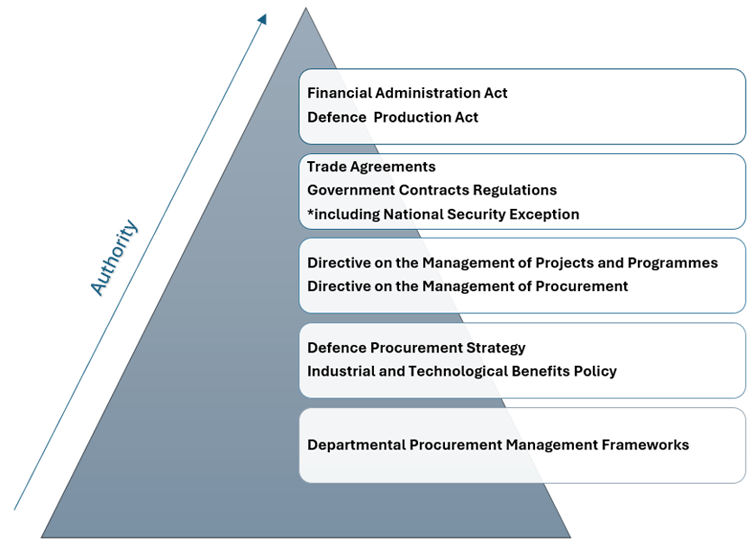
Image description
A pyramid represents a hierarchy of authority, with the top indicating the highest legal authority and the base the lowest. The pyramid is divided into 5 layers, stacked in order from bottom to top:
- (bottom) “Departmental Procurement Management Frameworks”
- “Defence Procurement Strategy” and “Industrial and Technological Benefits Policy”
- “Directive on the Management of Projects and Programmes” and “Directive on the Management of Procurement”
- “Trade Agreements,” “Government Contracts Regulations” and “*including National Security Exception”
- (top) “Financial Administration Act” and “Defence Production Act”
While this rules framework establishes how defence procurement is governed, delivery occurs through a system of departments and governance structures responsible for executing procurements within defined authorities. The following section describes these actors and their roles within the broader defence procurement system.
Key government actors in the Canadian defence procurement system
Canadian defence procurement is managed through a decentralized network of organizations with interwoven roles and responsibilities. This section provides an overview of the key government organizations involved.
Department of National Defence and the Canadian Armed Forces
Although closely linked, the Canadian Armed Forces (CAF) and the Department of National Defence (DND) are distinct organizations with complementary responsibilities that work together under the Minister of National Defence to deliver Canada’s defence objectives. CAF is led by the Chief of the Defence Staff, who is responsible for its command and administration, and DND is led by the Deputy Minister who oversees departmental policy, resources, and interdepartmental and international defence coordination in support of the CAF.Footnote 39
The CAF protects Canada at home and abroad and serves as the end user of military capabilities. While the CAF does not hold independent procurement authority beyond authorities delegated by the Minister of PSPC under the Defence Production Act, it identifies capability gaps, defines operational needs, and provides technical requirements that shape acquisition projects. Once these needs are established, DND, as the civilian department, leads project planning, approval, procurement, and delivery within a detailed framework of federal policies and governance mechanisms.Footnote 40
Public Services and Procurement Canada
Public Services and Procurement Canada (PSPC) is the central purchasing authority of the Government of Canada and acquires goods, services and construction on behalf of federal departments and agencies valued above individual departments’ spending authorities. PSPC is responsible for ensuring procurement is conducted in a manner that is fair, open, and transparent, aligns with government policies, and delivers value for money.Footnote 41 Its role involves leading procurement processes including industry and stakeholder engagement, developing procurement strategies, managing solicitation and evaluation processes, awarding and administering contracts, and ensuring vendor performance. There are several organizations within PSPC supporting defence procurement.
- PSPC Defence and Marine Procurement Branch (PSPC-DMPB) is responsible procurements for land, sea, and air projects, as well as associated in-service support contracts. As lead of the Defence Procurement Strategy Secretariat, PSPC-DMPB guides and coordinates interdepartmental defence procurement governance.Footnote 42
- PSPC Washington Sector (PSPC-W) is an office within PSPC-DMPB located at the Embassy of Canada in Washington, D.C., and serves as Canada’s permanent procurement presence in the U.S. PSPC-W manages defence and security procurement activities involving the U.S. government, particularly where government to government (G2G) procurement mechanisms are required, and acts as Canada’s single procurement window for purchases made through the U.S. Department of Defense’s Foreign Military Sales (FMS) program.Footnote 43
- PSPC Procurement Branch (PSPC-PB) conducts procurements on behalf of federal departments and agencies, including DND, in support of a broad range of operational and sustainment requirements. This includes procurement of goods and services such as food, clothing, specialized vehicles and equipment (e.g., firetrucks), as well as research and development (R&D) activities.
The Defence Investment Agency (DIA) was established in 2025 as a Special Operating Agency within PSPC led by the Secretary of State for Defence Procurement and overseen by the Chief Executive Officer. The DIA’s mandate is to modernize and accelerate defence procurement, reduce duplication and administrative burden, centralize expertise, enhance industry engagement, strengthen collaboration with allies, and ensure the CAF receives needed equipment in a timely manner; all while strengthening domestic industry, innovation, and economic growth.Footnote 44
The 2026 Defence Industrial Strategy (DIS) positions the DIA as a central vehicle for procurement reform, supporting a new Build-Partner-Buy framework, and acting as the procurement hub for major defence investments. The Agency manages large-scale procurements and, in December 2025, announced that it had been managing 8 priority defence procurements that had been underway since October.Footnote 45 The DIS further mentions the Government’s intention to establish the DIA as a stand-alone entity through the introduction of legislation in 2026.Footnote 4 That intention has since progressed: on May 7, 2026, the government announced the introduction of Bill C-31, which includes establishing the DIA as a stand-alone entity and is currently under review.Footnote 46
Innovation, Science and Economic Development Canada
Innovation, Science and Economic Development Canada’s (ISED) mandate is to strengthen Canada’s economic competitiveness by improving conditions for investment, supporting innovation, expanding trade, and ensuring a fair and competitive marketplace.Footnote 47
In defence procurement, ISED ensures that major contracts generate Canadian economic benefits through its role as lead administrator of the Industrial and Technological Benefits (ITB) Policy, helping drive jobs, innovation, and long‑term industrial capacity.Footnote 48 ISED also maintains Canada’s Key Industrial Capabilities that are priority technology and capability areas used to target industrial benefits, aligning defence spending with economic growth and national security priorities.Footnote 49 In addition, ISED conducts economic analysis, market research, and industrial capability assessments to support evidence‑based procurement and ITB decision‑making.Footnote 50
Treasury Board and the Treasury Board of Canada Secretariat
The Treasury Board (TB) is a statutory Cabinet committee established under the Financial Administration Act. The Treasury Board of Canada Secretariat (TBS) is a central agency that supports the TB. TB is responsible for decision-making with respect to expenditures and authorities, including the approval of high-risk and high-complexity defence procurements.Footnote 51
TBS plays a critical role in the defence procurement system by designing and administering the policy and directive framework approved by TB, and providing government‑wide oversight of spending, administrative management, public service employer relations, and regulatory practices. Through this role, TB establishes the management requirements and approval thresholds that govern major defence projects.Footnote 52
In practice, TBS acts as the primary interface between departments and TB for defence procurement approvals. TBS analysts review and challenge departmental proposals, provide advice to TB ministers, and coordinate Treasury Board submissions for decision.Footnote 53 As a result, TBS exercises considerable influence over the shaping, timing, and approval of the largest, highest‑risk, and most complex defence procurements, particularly those exceeding departmental delegated authorities.
Global Affairs Canada
Global Affairs Canada (GAC) is responsible for Canada’s diplomacy, international relations, and international trade. In major defence procurements, GAC supports projects that involve foreign suppliers, allied governments, or international industrial partnerships, helping manage diplomatic considerations, market access, and cross‑border coordination that enable Canada to acquire advanced military capabilities.Footnote 54 GAC also administers Canada’s export regime under the Export and Import Permits Act ensuring alignment with security frameworks for sensitive, military and dual‑use items.Footnote 55
Crown corporations
Crown corporations contribute specialized functions to Canada’s defence procurement system that fall outside the mandates of federal departments. 2 key Crown corporations with direct roles in defence‑related projects are mentioned below.
- Defence Construction Canada (DCC) was created in 1951 as a Crown corporation to deliver construction contracting, contract management, infrastructure and environmental services, and lifecycle maintenance for defence-related projects.Footnote 56 DCC primarily supports the DND and the Communications Security Establishment (CSE), enabling the delivery of secure facilities, operational infrastructure, and specialized construction requirements.Footnote 57 DCC reports to Parliament through the Minister of Government Transformation, Public Works and Procurement.
- Canadian Commercial Corporation (CCC), founded in 1946, has an export-focussed mandate, helping Canadian suppliers access international government procurement markets through government-to-government (G2G) contracts.Footnote 58 CCC also facilitates foreign government purchases from Canada and plays a role in defence-related international assistance by executing G2G contracts on behalf of DND and the CAF.Footnote 59 CCC reports to Parliament through the Minister of International Trade, Export Promotion, Small Business and Economic Development.
The visual below illustrates how these organizations interact and coordinate across the defence procurement system.
Figure 2—Government actors in major defence procurement
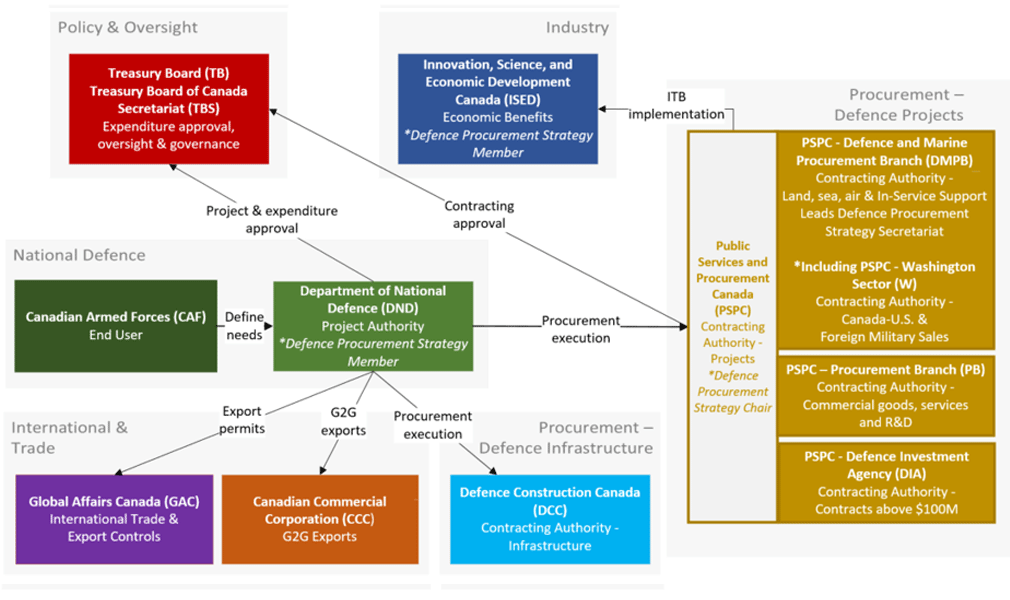
Image description
A mind map illustrates the roles and relationships among Canadian government organizations involved in defence procurement. The layout is divided into 6 sections:
- Policy & Oversight (top left) includes: the Treasury Board (TB) and Treasury Board of Canada Secretariat (TBS) providing expenditure approval, oversight & governance. TB approves project and expenditure decisions for DND, and provide contracting approval for PSPC.
- Industry (top centre) includes: Innovation, Science, and Economic Development Canada (ISED), a member of the Defence Procurement Strategy, responsible for evaluating the project’s Economic benefits, and implementing the ITB for PSPC.
- National Defence (centre) includes:
- Canadian Armed Forces (CAF) defines needs for DND as the end user.
- Department of National Defence (DND), a member of the Defence Procurement Strategy, and project authority.
- International & Trade (bottom left) includes:
- Global Affairs Canada (GAC) manages international trade & export controls and export permits for DND.
- Canadian Commercial Corporation (CCC) manages G2G exports for DND.
- Procurement—Defence Projects (centre right) includes:
- Public Services and Procurement Canada (PSPC), the Defence Procurement Strategy Chair, is the contracting authority for projects and executes procurement for DND through 3 bodies:
- PSPC—Defence and Marine Procurement Branch (DMPB), the contracting authority for land, sea, air, & In-Service Support, and lead of the Defence Procurement Strategy Secretariat”. This branch also includes PSPC—Washington Sector (W) as the contracting authority for Canada-U.S. & foreign military sales.
- PSPC—Procurement Branch (PB) is the contracting authority for commercial goods, services, and R&D.
- PSPC—Defence Investment Agency (DIA) is the contracting authority for contracts above $100 million.
- Public Services and Procurement Canada (PSPC), the Defence Procurement Strategy Chair, is the contracting authority for projects and executes procurement for DND through 3 bodies:
- Procurement—Defence Infrastructure (bottom right) includes: Defence Construction Canada (DCC) who is the contracting authority for infrastructure, executing procurement for DND.
With key federal rules and organizations now outlined, the next section examines how these actors work together throughout the lifecycle of a major defence procurement. The Canadian defence procurement process involves a series of structured phases, decision points, and accountabilities that guide projects from initial capability identification through to delivery. The following section provides an overview of this process and how the previously described departments, agencies, and Crown corporations contribute at each stage.
The defence procurement process for major projects
This section provides an overview of the legacy procurement process to acquire major defence capabilities. While it remains unclear how this process may change as a result of the establishment of the Defence Investment Agency and release of the Defence Industrial Strategy, understanding the existing process and associated challenges that have shaped past outcomes is essential to assessing the viability of proposed reforms. The process described in this section and the accompanying visual were developed by OPO based primarily on publicly available Government of Canada information, and are intended to illustrate how key federal actors, including DND, PSPC, ISED, and TBS, are involved in the procurement process for the high-risk, high-complexity projects.
At the centre of this system is DND’s “Defence purchases and upgrades process”, a foundational project management framework that guides major acquisitions.Footnote 60 Aligned with the TB Directive on the Management of Projects and Programmes, the framework follows a structured 5‑phase approach to ensure the capabilities being acquired are justified, affordable, aligned with government policy, and responsive to CAF operational needs.Footnote 61
The high‑level project process shown below highlights the procurement activities embedded within each phase and illustrates the integrated nature of project and procurement processes. For simplicity, internal DND governance boards and detailed review steps are not depicted; the focus is on the procurement process itself to acquire capability.
Publicly available sources, including DND’s outward facing website containing project webpages that provide project and phase-level information, were not current, complete, consistent, or clearly reported, which limited its reliability for determining phase‑level and overall project durations.Footnote 62 Based on limited information drawn from DND project webpages and other publicly available sources, it is estimated that a major DND project requires, on average, approximately 16 years to progress through the 5 project phases, with an observed range of approximately 7-28 years.Footnote 63
Phase 1: Identification (Define military capability deficiency and develop high-level requirements)
The Identification phase begins as the CAF identifies a military capability deficiency or emerging operational need. Based on this need, DND/CAF develop High‑Level Mandatory Requirements (HLMRs), outlining the core capabilities the future equipment or service must deliver, to be further developed and refined in the next 2 phases.Footnote 64
Little to no procurement activity typically occurs at this stage and PSPC and ISED are generally not engaged. However, under the Defence Procurement Strategy, DND engages the Independent Review Panel for Defence Acquisition (IRPDA) to provide arm’s‑length advice to the Minister of National Defence on projects and project requirements—including potential impacts on competition and procurements—for major projects over $100 million, and for other projects on an as-needed basis.Footnote 65 The IRPDA board is composed of 5 external experts, 1 Chair and 4 members (e.g., academics or former public servants), and supports the validation of early requirements for major projects.Footnote 66
The IRPDA conducts the first of 2 reviews at the end of the Identification Phase and the beginning of the Options Analysis of the HLMRs to assess potential effects on competition, the validity of cost assumptions, and risks related to schedule delays. The second IRPDA review occurs near the end of the Options Analysis phase, once project requirements are further developed.Footnote 67
Phase 2: Options Analysis (Refine requirements, develop the business case, initiate industry engagement, and develop the procurement strategy)
In the Options Analysis phase, DND refines the HLMRs into the Preliminary Statement of Operational Requirements (PSOR) and develops a business case presenting options to address the requirements that will be submitted for approval by DND senior management and the TB at the end of this phase.Footnote 68
Procurement activities usually begin in this phase under the Defence Procurement Strategy (DPS). As lead of the DPS Secretariat, PSPC establishes and chairs the interdepartmental DPS governance committee for the procurement, which brings together executives and working‑level teams from PSPC, DND, and ISED to make consensus decisions throughout the procurement process.Footnote 69 DND engages PSPC and ISED to share its technical requirements and project context to support procurement planning and the assessment of potential economic benefits. PSPC, as the procurement lead and contracting authority, uses this information to initiate procurement activities while ISED assesses economic benefits opportunities under the Industrial and Technological Benefits (ITB) Policy.Footnote 35 PSPC usually appoints an independent Fairness Monitor for procurements meeting certain criteria (e.g., competitiveness, value, risk) to observe the process, provide advice, and issue a final report following contract award.Footnote 70
The DPS governance committee approves 3 key procurement milestones, with the first 2 occurring during this Options Analysis stage:
- Milestone 1: Interdepartmental cooperation plan and industry engagement approach
- Milestone 2: Procurement strategy
- Milestone 3: Solicitation approach (approved in subsequent Definition phase, prior to solicitation)
During Options Analysis, PSPC leads industry engagement activities approved under Milestone 1, which can include a range of engagement tools such as Industry Days, Requests for Information (RFIs), Invitations to Qualify (ITQs), the establishment of a list of prequalified suppliers, supplier site visits, supplier meetings, and, in some cases, the release of draft Requests for Proposals (RFPs) for early feedback.Footnote 71 Feedback from these tools helps the government assess industry capabilities and readiness, in addition to cost and schedule implications and potential economic benefits, which inform the development of the procurement strategy.
PSPC, working with DND and ISED, develops the procurement strategy for approval of Milestone 2. The strategy details the acquisition approach (e.g., competitive versus sole source, single-step versus multi-step solicitation process, etc.) and considers technical requirements, cost, schedule, economic benefits, Indigenous considerations, security requirements, trade agreements, and other factors.Footnote 72 The procurement strategy is one of the elements that feeds into DND’s TB submission at the end of this phase.
Toward the end of this phase, the IRPDA conducts a second review, this time to examine the business case and the PSOR, including review of any procurement implications, and again provides independent advice to the Minister of National Defence.Footnote 73
The end of the Options Analysis phase typically supports a project decision, which may be through a DND TB submission for Expenditure Authority to undertake Definition phase activities. A TB submission is a necessary step for projects that have been assessed as high-risk and high-complexity, though the significant majority of projects typically fall within DND’s departmental limits and do not require a TB submission. Before submitting, DND must secure a source of funds (e.g., a funding decision from the Department of Finance) and a policy approval when required, which is usually received through a Memorandum to Cabinet and can take up to 12-18 months for the most complex projects.
DND’s TB submission must be supported through a Project Brief, which includes an overview of the project and associated business case results. Elements include project objectives, expected benefits, scope, schedule, project and life-cycle cost estimates, procurement strategy including industry information, risk management plan, performance and outcomes measures, governance and management approach, overall assessed complexity, and other elements. Other documents may be requested by TBS, such as the Business Case, Project Management Plan, Project Gating Plan, Procurement Plan, Project Charter, or other documents as required.Footnote 74 The TB approval process can take 9-12 months or longer to complete according to one defence procurement expert interviewed by OPO. Once the submission is approved by the TB, the project moves to the Definition phase.
Phase 3: Definition (Finalize requirements and develop the solicitation approach)
In the Definition phase, DND finalizes requirements by refining the PSOR into a final Statement of Operational Requirements (SOR). Project cost estimates are refined, and DND prepares a comprehensive project management plan covering the full lifecycle of the capability.Footnote 75
PSPC leads the development of the solicitation approach in collaboration with DND and ISED, ensuring alignment with the approved procurement strategy, which considers elements such as evaluation criteria, security requirements, intellectual property provisions, the weighting of technical, industrial benefits, and price factors. The DPS governance committee approves the final solicitation approach at DPS Milestone 3 to initiate the solicitation process. For competitive procurements, PSPC usually then issues a formal RFP, which may remain open for several months to over a year depending on complexity and factors such as whether Canada decides to conduct one‑on‑one clarification meetings or extend a site visit opportunity to bidders at CAF bases where the capability will be operated or maintained.Footnote 62
After the RFP closes, PSPC leads the bid evaluation process, which often takes months or years to complete depending on complexity. This is followed by contract negotiations and finalization with the successful bidder.Footnote 62
Toward the end of this phase, DND seeks approval, which may include submitting a TB submission for both Project Approval and Expenditure Authorities, to proceed to the Implementation phase.Footnote 76 This approval establishes the project baseline, including scope, cost, and schedule, and authorizes DND to spend funds for equipment acquisition, associated systems, infrastructure, training, IT, and sustainment. The project can involve multiple contracts to deliver the full capability, which are included in the submission.Footnote 61
Before a contract can be signed, PSPC must obtain additional contracting approval from the TB if the estimated contract value exceeds PSPC’s limits set by the TB.Footnote 33
Phase 4: Implementation (Contract execution, contract administration, and capability delivery)
Following TB approval, PSPC signs the contract with the successful supplier, marking the transition to the Implementation phase. At this point, the Fairness Monitor, engaged by PSPC at the outset of the procurement process for applicable contracts, issues a final report of their observations, including an assessment of whether the procurement was conducted in a fair, open, and transparent manner.Footnote 77
During Implementation, PSPC manages the contract and is accountable for contract performance and change management. DND as the technical authority, and ISED as the ITB Policy authority, also play key roles in verifying that deliverables meet their respective contractual requirements. Any contract amendments arising during administration that increase scope or costs beyond TB-approved limits require DND or PSPC, or both, to return to TB to seek additional project, expenditure, or contracting authority.
Support contracts associated with the capability acquisition are executed in parallel during the Implementation phase, including those for infrastructure, training, weapons, and other enablers required to bring the capability to full operational status.
2 major capability delivery milestones occur in the Implementation phase, as previously defined in the SOR:
- Initial Operational Capability (IOC): Achieved when a minimum set of systems, personnel, training, and support are in place to use the capability at a basic operational level.
- Full Operational Capability (FOC): Achieved when all required equipment, training, personnel, infrastructure, and support are delivered, and the capability is fully usable across its intended missions.Footnote 78
At or shortly before IOC, when the equipment begins to enter service, In-Service Support (ISS) is initiated and continues for the duration of the capability’s useful life to sustain the equipment. ISS is planned during the project acquisition and may be delivered through the same contract to acquire the equipment, or through a separate sustainment contract, often managed by PSPC, depending on the sustainment approach selected. ISS encompasses the full range of activities required to operate, maintain, and support a defence capability once it enters service, ensuring that it remains safe, effective, and available throughout its operational life. These activities typically include maintenance and repair, spare parts and supply chain management, software support and upgrades, training and simulation, engineering support, and obsolescence management.Footnote 79
As the project progresses toward FOC, acquisition activities gradually wind down while ISS activities expand under their respective contracts. Once acquisition-related deliverables are completed, the project transitions toward close-out, while sustainment continues as the enduring phase of the lifecycle. ISS activities continue to sustain and support the equipment throughout its operational life, which commonly spans several decades, often 20-40 years or longer, depending on the expected lifespan of the asset.Footnote 80
Upon completion of acquisition-related contract deliverables, PSPC undertakes final contract close‑out activities, including financial reconciliation, audits (as applicable), final payments, and the disposition or transfer of any Crown‑owned property.
Phase 5: Closeout (Formal closeout of the acquisition project and completion of lessons learned)
In the Closeout phase, the DND project team completes a lessons‑learned exercise and provides final briefings to senior management confirming that Full Operational Capability (FOC) has been achieved. Once verified, the team closes project accounts and finalizes all remaining administrative activities, formally concluding the project.Footnote 81
The visual below illustrates the 5‑phase acquisition project process and shows how procurement activities are embedded within each phase. It highlights the integrated nature of project management and procurement processes across major defence acquisitions.
Figure 3—Defence procurement process for major projects
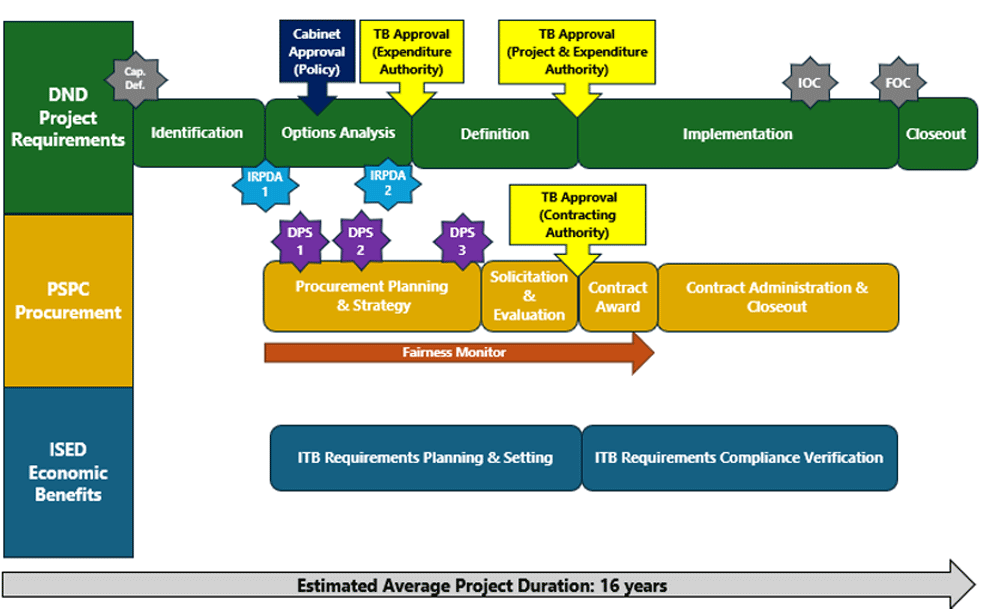
Image description
This diagram shows the procurement process for major defence procurement projects in Canada, with parallel roles for DND, PSPC, and ISED. The flow runs left to right.
3 vertical columns on the left are labeled:
- “DND, Project Requirements”
- “PSPC, Procurement”
- “ISED, Economic Benefits”
Across the top, a horizontal sequence of 5 steps represent activities undertaken by DND:
- “Identification”
- “Options Analysis”
- “Definition”
- “Implementation”
- “Closeout”
Major milestones in the DND activities include:
- The “Identification” phase begins with a “Cap. Def.” (Capability Definition) by the Canadian Armed Forces (CAF). IRPDA1 takes place at the end of the Identification phase and start of Options Analysis phase.
- In the “Options Analysis” phase, “Cabinet Approval (Policy)” takes place roughly one-third into the phase. IRPDA2 takes place near the end, and “TB Approval (Expenditure Authority)” takes place at the end of the phase.
- The “Definition” phase ends with a “TB Approval (Project & Expenditure Authority)”.
- During the “Implementation” phase, “IOC” (Initial Operational Capability) takes place near the end of this phase, while “FOC” (Full Operational Capability) occurs slightly after IOC
Below DND, a horizontal sequence of 4 steps represent the procurement activities led by PSPC:
- “Procurement Planning & Strategy” (extends from DND’s “Options Analysis” phase to the middle of the “Definition” phase)
- “Solicitation & Evaluation” (extends from the middle of DND’s “Definition” phase to the end of that phase)
- “Contract Award” (extends from the start of DND’s “Implementation” phase)
- “Contract Administration & Closeout”(extends to the end of DND’s “Implementation” phase)
Major milestones in the procurement activities include:
- DPS1, 2, and 3 (Defence Procurement Strategy) occur sequentially during the “Procurement Planning & Strategy” phase.
- A long horizontal arrow labeled “Fairness Monitor” runs beneath PSPC’s procurement activities row, spanning most of the process from the start of “Procurement Planning & Strategy” to the end of “Contract Award”, indicating oversight throughout.
Below PSPC are 2 economic benefits main activities led by ISED:
- “ITB Requirements Planning & Setting”, which begins at the start of DND’s “Options Analysis” phase to the end of DND’s “Definition” phase.
- “ITB Requirements Compliance Verification”, which starts and finishes concurrently with DND’s “Implementation” phase.
Finally, along the very bottom, a long horizontal arrow states: “Estimated Average Project Duration: 16 years,” indicating the full timeline from start to finish.
Having examined Canada’s defence procurement system and how major projects move through it, Volume 1 of this report on defence procurement will conclude with an overview of reforms set to significantly shape the system’s future, notably the establishment of the DIA and the release of the DIS.
Reforms laying the foundation for change: the Defence Investment Agency and the Defence Industrial Strategy
The Defence Investment Agency
The Defence Investment Agency (DIA) was established in 2025 to address longstanding challenges in Canada’s defence procurement system, including fragmented responsibilities, complex approval processes, and prolonged acquisition timelines. The aim of the Agency is to accelerate the delivery of equipment to the CAF while better aligning defence procurement with Canada’s industrial and economic objectives.Footnote 3
Currently housed within PSPC and overseen by the Secretary of State for Defence Procurement, the DIA was created to consolidate defence procurement processes, reduce duplication, and bring centralized expertise to planning and executing acquisitions. A key objective is to provide greater clarity and predictability for both the CAF and industry, enabling procurements to advance more quickly and with fewer delays.Footnote 82
The DIA’s mandate extends beyond procurement efficiency to using defence spending as a strategic investment tool. The Agency is tasked with strengthening domestic defence industrial capacity, supporting advanced manufacturing and innovation, and enabling Canadian firms to scale and compete internationally. The DIA’s mandate also emphasizes earlier and more structured engagement between the military and industry to better align requirements, costs, timelines, and technological options. The 2026 Defence Industrial Strategy (DIS) explicitly refers to the DIA as being at the centre of the DIS and its implementation.Footnote 83
Through these reforms, the DIA is intended to support Canada’s commitment to increased defence spending, improve alignment with key allies, and ensure the CAF has timely access to modern, reliable capabilities while reinforcing Canada’s defence industrial base.
Overall, the DIA represents a significant structural reform intended to accelerate defence procurement and modernize Canada’s defence industrial base. The 2026 proposed legislation to stand up the DIA as a stand alone entity will bring clarity to its authorities and mandate, which is critical to ensuring the Agency is empowered to meet its ambitions.Footnote 84 Its success will ultimately depend on clear accountability, sufficient mandate authorities, sustained commitment, and strong execution in delivering contract outcomes within established procurement timelines.
Canada’s Defence Industrial Strategy
The 2026 Defence Industrial Strategy (DIS) is an ambitious plan that sets out Canada’s intent to build, fund, and sustain its defence industrial base to strengthen defence sovereignty and modernize procurement to better equip and support the CAF.Footnote 85 It responds to an evolving global security environment and growing pressures on defence supply chains, acknowledging that Canada has become overly dependent on foreign suppliers due in part to a procurement system that has often been slow, complex, and unable to meet the CAF’s needs.
The DIA is at the centre of the Strategy’s implementation and focuses on building a stronger and more competitive Canadian defence industrial base so that more defence related goods, services, and technologies are developed and produced in Canada. The DIS identifies 10 Key Sovereign Capability areas that are critical to Canada’s national defence and are intended to guide where the Government will most actively align procurement, investment, and industrial policy to ensure Canada retains critical domestic defence capabilities over the long term.Footnote 86
A central feature of the DIS is the “Build-Partner-Buy” approach, which is designed to Build in Canada whenever possible; Partner with trusted allies—such as the U.S., EU, U.K., and Indo‑Pacific countries (e.g., Australia, New Zealand, Japan, Republic of Korea)—when domestic production is not feasible; and Buy from allies only when necessary and with strong domestic benefit requirements built in.Footnote 87 The DIA will play a key role in operationalizing this approach, anticipated to make procurement faster, more predictable, and more aligned with long‑term capability needs.
The Strategy also introduces Canada’s intent to establish strategic, long-term partnerships with selected defence companies, or “Canadian champions”, to build world‑leading capabilities to meet Canada’s critical needs. To support this approach, the Government published a framework, entitled the Strategic Partnership Framework on May 27, 2026 which explains the process for identification and onboarding of select defence suppliers as key strategic partners.Footnote 88
The Strategy is also an ambitious economic investment plan aimed at achieving the following results over the next 10 years:
- Building world-leading Canadian firms in key sovereign capability areas
- Increasing Research and Development (R&D) investment by 85%
- Accelerating procurement of successful Canadian defence R&D innovations
- Raising the share of defence contracts awarded to Canadian firms to 70%
- Boosting Canadian defence industry revenues by more than 240%
- Increasing fleet serviceability for maritime by 75%), land by 80%, and aerospace by 85%
- Growing defence exports by 50%
- Generating up to 125,000 new jobs by 2035Footnote 89
The DIS also signals upcoming changes, including legislation introduced via Bill C 31 to establish the DIA as a stand alone entity (introduced May 7, 2026 and currently under review),Footnote 46 and early 2026 reforms to the Industrial and Technological Benefits (ITB) Policy updating Canada’s Key Industrial Capabilities (announced May 27, 2026).Footnote 46
Volume 1: Conclusion
The Defence Industrial Strategy and creation of the Defence Investment Agency mark a structural shift in how Canada approaches defence procurement, industry, and investment. These changes have the potential to shift Canada away from a project‑by‑project procurement model toward a more strategic, system‑based defence industrial approach, addressing long‑standing structural weaknesses that process reforms alone could not resolve.
Volume 1 outlined the legacy defence procurement system for major projects, highlighting a lengthy and complex process that has contributed to stalled procurements and capability gaps for the Canadian Armed Forces. While recent reforms represent an important step forward, sustained improvement will depend on consistent implementation and follow‑through over time. Achieving a more effective defence procurement model requires a clear understanding of the challenges that have shaped past outcomes and a continued commitment to addressing them as the new system takes shape.
Volume 2 builds on this foundation by examining key challenges and emerging opportunities Canada must navigate to modernize defence procurement, particularly for major defence projects, and enable the timely delivery of capabilities required in an increasingly complex and uncertain security environment. Volume 2 also presents considerations for Canada as it pursues further reforms, emphasizing that success will be judged not by ambition, but by the ability to translate reform into timely, concrete outcomes for the Canadian Armed Forces, Canadian industry, and Canadians.
Volume 2: Defence procurement challenges and considerations in the context of ongoing reform
Volume 1 of this report provided a high‑level overview of Canada’s legacy defence procurement system. This overview, however, only scratches the surface of a process that has, in practice, been overly complex, time‑consuming, costly, risk‑averse, and one that ultimately has fallen short in delivering timely capability to the Canadian Armed Forces. Long-overdue change has arrived with the establishment of the Defence Investment Agency (DIA) on October 2, 2025,3 and the release of the Defence Industrial Strategy (DIS) on February 17, 2026.Footnote 91 These changes mark a shift in how Canada intends to leverage defence procurement as a strategic function to advance military capability, innovation, and economic benefits while reinforcing sovereignty and international credibility.
Volume 2 of this report examines key challenges associated with Canada’s legacy defence procurement system and identifies areas for consideration by Canada in the context of these 2 new significant reforms. The focus areas of this Volume are informed by insights gathered through expert interviews, most of which were conducted following the establishment of the DIA but prior to the release of the DIS.
While most, if not all, interviewees expressed optimism regarding Canada’s renewed focus on defence and anticipated procurement reforms, they also highlighted a range of persistent issues affecting procurement processes and outcomes. Many of these challenges are explored below and warrant careful consideration as Canada determines how defence procurement, particularly for major projects, will be structured and executed going forward.
Reducing complexity in a procurement system constrained by fragmented accountability and data gaps
One of the most persistent criticisms of Canada’s defence procurement system is the diffuse accountabilities spread across the Department of National Defence (DND), Public Services and Procurement Canada (PSPC), Innovation, Science and Economic Development Canada (ISED), and Treasury Board of Canada Secretariat (TBS), as described in Volume 1 of this report. In Canada’s decentralized system, each organization defines success through a different institutional lens. For DND, success is the timely delivery of military capability. For PSPC, it is a fair, open, and transparent procurement process. ISED focuses on economic and industrial benefits, while TBS prioritizes risk management and cost control. Each perspective reflects a legitimate mandate; however, defence procurement cannot maximize all objectives simultaneously.
As a result, there is no shared definition of what constitutes “successful” defence procurement. Instead, success is assessed through institution‑specific lenses, with limited mechanisms to reconcile trade‑offs among competing objectives. The result is a siloed, slow system that lacks a strategic focus to deliver for Canada.
This section examines 3 interrelated challenge areas linked to decision-making that contribute to delays and inefficiencies in Canada’s defence procurement system: the Defence Procurement Strategy, the Treasury Board approval process, and the structure of delegated authorities that execute decision-making. It concludes by briefly considering how limited, system‑wide procurement data constrains transparency and performance measurement, reinforcing siloed accountability and reducing the system’s ability to identify delays, learn from experience, and adapt over time.
Defence Procurement Strategy
Consideration 1: Canada could consider establishing a clear framework of guiding principles to articulate how technical requirements, economic benefits, cost, and schedule are to be weighed in major defence procurement decisions, including how trade-offs among these elements should be resolved when tensions arise.
Major defence procurements are governed by the Defence Procurement Strategy (DPS) under which PSPC, DND, and ISED make consensus-based decisions at key procurement milestones and throughout the contract lifecycle. Introduced in 2014, DPS marked an important step toward improving interdepartmental coordination.Footnote 91 However, departments must still obtain approvals through their own vertical approval structures in parallel with DPS decision‑making, resulting in multiple governance streams that contribute to friction, delays, and duplication.
DPS is grounded in 3 core objectives: (1) delivering the right capability to the CAF and the Canadian Coast Guard in a timely manner; (2) leveraging defence procurement to generate economic benefits for Canada; and (3) streamlining procurement process.Footnote 34 In practice, however, the first 2 objectives often conflict. Efforts to maximize economic benefits can increase timelines and costs, particularly where equipment is mature or sourced internationally and where domestic production or sustainment capacity is limited.
Economic considerations cannot be viewed in isolation and must be considered alongside technical, security, and interoperability requirements, including integration with existing CAF and allied systems, supply‑chain security, long‑term sustainment, and access to upgrades. As one interviewee pointed out, information‑sharing benefits with strategic allies may also factor into decisions. These competing priorities make trade‑offs inevitable and highly complex, yet no clear documentation describing how DPS governance resolves trade‑offs between timely capability delivery and economic benefits exists. The lack of a unified framework for establishing project priorities increases the risk of inconsistent decision‑making under pressure. In practice, a clear statement of precedence, such as prioritizing operational capability over industrial outcomes in certain cases, would provide necessary discipline and predictability.
Experts consistently described the system as slow, overly hierarchical, and burdened by excessive senior‑level approvals, resulting in inefficiency and extended timelines. Despite significant changes in Canada’s defence environment since 2014, DPS has remained largely unchanged. In today’s security context characterized by rapidly evolving threats and technologies, procurement timelines must align with operational relevance. As one interviewee emphasized, “schedule is king” in delivering capability to the CAF.
Some interviewees also noted that PSPC, and particularly ISED, are often engaged late in the process after requirements are largely defined, limiting opportunities to meaningfully shape economic outcomes through DPS and increasing the risk of inadvertently embedding industrial preferences into requirements. Earlier engagement could better support industrial planning while reducing the risk of bias.
The creation of the DIA introduces an accelerated procurement pathway for priority projects valued above $100 million, although this threshold may be lowered over time as the agency evolves.Footnote 92 Alongside this new pathway, the legacy procurement system continues to apply to all other projects. As a result, Canada now effectively operates 2 defence procurement pathways: a streamlined, DIA‑led process for higher‑value projects and a slower legacy process for medium and lower‑value procurements. As one interviewee noted, from a risk and efficiency perspective, applying a more cumbersome process to lower‑value projects appears counterintuitive. Requiring industry to navigate 2 distinct procurement pathways increases complexity and uncertainty within an already inefficient system. With the anticipated growth in defence spending and procurement activity, clear direction is needed to ensure coherence across both pathways and to avoid duplication, confusion, and avoidable delays.
Treasury Board approval
Consideration 2: Canada could consider embedding Treasury Board of Canada Secretariat (TBS) personnel within the Department of National Defence (DND) to strengthen early alignment on projects, support teams in anticipating and meeting Treasury Board submission requirements, and streamline the approval process. This potential approach would need to take into consideration the risks related to conflict of interest and blurring of responsibilities between TBS and DND.
Operating outside the DPS decision‑making structure, the Treasury Board (TB) approval process serves as a central oversight and authorization mechanism for major defence procurements, with approvals required at multiple points throughout a project’s lifecycle, contributing to added procedural complexity. For high-risk, high-complexity major defence projects, DND seeks Project Approval Authority and Expenditure Authority from TB to spend funds based on approved scope, schedule, and cost, while PSPC is required to obtain contracting approval from TB prior to contract award when the contract value or risk exceeds its limits. Together, these approvals are intended to ensure that significant public expenditures are justified, aligned with policy, and properly controlled.
Under TB policy, DND must submit a 5‑year Defence Investment Plan to TBS at least every 3 years which can provide early visibility of upcoming projects expected to require TB approval. When a specific project requires TB approval, DND leads development of the TB submission, drawing on inputs from PSPC for procurement planning and ISED for Industrial and Technological Benefits considerations. TBS then conducts a detailed review of the submission, often involving several rounds of revisions. Once TBS’ review is complete, submissions are advanced to TB ministers, who may request additional clarification before approving.
Major defence projects typically span multi-year timelines and high-risk, high-complexity projects often require multiple TB submissions by DND and PSPC over the course of the project’s lifecycle to address evolving scope, costs, and contract amendments.
Despite internal service standards indicating TB approvals can be completed within approximately 9 weeks for a well documented submission, defence procurement experts consistently reported that approvals extend many months, often taking 9-12 months or longer in practice. As one expert pointed out, this gap reflects limited understanding of TBS roles, authorities, and processes across the defence procurement ecosystem.
What we heard from defence procurement experts on the Treasury Board approval process
Several experts identified a number of systemic challenges with the TB submission and approval process, including risk aversion, misalignment between cost and capability development, process burdens, and limited early and forward‑looking engagement.
- Risk aversion and challenge function: TBS has an overactive challenge function, is perceived as highly risk-averse, and applies little emphasis on schedule considerations. Many TBS questions have already been addressed through other project gates.
- Misalignment between cost estimates and capability requirements: Cost estimates and funding are often set and challenged before requirements are fully defined. Major project costs are often overly challenged, creating pressure to underestimate (“low-ball”) estimates to obtain approval—an issue described as a fundamental system flaw.
- Process burdens: TB submissions can run 60-100 pages and take 9-12 months or longer to secure approval. There is an insufficient number of TB project slots for defence files, and limited TBS resources available to work on defence files. However, one interviewee acknowledged TBS’ efforts to streamline processes in recent months.
- Submission-driven engagement: TBS detailed engagement usually begins once a submission is received. When departmental submissions do not fully meet expectations, this usually triggers additional time and review.
- Limited departmental capacity: The same personnel managing procurement files are often implicated in the drafting and justifying of departmental submissions, creating resource strain and slowing progress.
- Insufficient lookahead: Ministers often lack a clear forward view of upcoming defence submissions, which could improve timeliness of approval.
Office of the Procurement Ombud observations on the Treasury Board approval process
When TBS is not meaningfully engaged to understand a project’s context, more questions, substantiation, and rework inevitably follow. Similarly, when DND project teams face repeated back‑and‑forth challenges from TBS, it often signals that expectations are unclear or not mutually understood. Although TBS participates in regular senior‑level oversight meetings with DND, PSPC and ISED, there remains a fundamental gap in how TBS and DND understand each other’s business processes and decision flows. By design, TBS involvement occurs primarily at key approval points, typically triggered by formal requests for project, expenditure, or contracting authorities rather than throughout early project development.Footnote 93 One interviewee noted that earlier engagement with TBS could help reduce timelines and administrative burden.
Multiple interviewees highlighted challenges with DND costing practices in TB submissions, particularly the difficulty of producing accurate cost estimates before requirements are fully defined. Improving understanding of how requirements maturity aligns with cost estimates at different phases of a project could help enhance cost accuracy and reduce the cycle of underestimation, resubmission, and delay affecting many major defence projects.
As it pertains to DND submissions, greater transparency of TB process steps and expectations is needed. Defence teams should not have to rely on trial and error to prepare submissions; increased, clearer guidance and more widespread training would help prevent avoidable delays.
One proposed solution is embedding TBS personnel within DND to follow projects more closely, participate in key review boards, and help teams anticipate and meet TBS requirements. This initiative would enable earlier identification and resolution of policy and risk issues, improve submission quality, reduce iterative challenge, and accelerate decision‑making without weakening oversight. This approach addresses coordination and timing issues inherent in the submission process but may slightly impact TB’s subsequent role in independent scrutiny and approval.
With the growing number of defence projects and rising defence spending, the system will require greater efficiency and predictability to ensure approvals move at the pace of relevance. At a minimum, more consistent TBS participation in early review and governance forums would strengthen mutual understanding of the defence procurement pipeline and support more seamless submission development.
Recent updates to the TB Directive on the Management of Procurement eliminate the need for a separate TB submission for DIA‑led contracts where the procurement plan has already been approved (which could occur through or at the time of DND’s TB submission), reducing duplicative approvals and supporting faster delivery of major defence procurements. This change would reduce the number of TB approvals required for a single project and aligns with the DIA’s objective to accelerate the delivery of major defence procurements.
Despite gains achieved through this DIA streamlining initiative, TB submissions led by DND occurring in the Options Analysis and Definition phases fall outside the DIA’s mandate and remain under the authority of the Minister of National Defence. This creates a structural limitation that constrains the government’s ability to accelerate major defence procurements at the front end of the process, particularly during requirements development. Without addressing these early decision and approval stages, efforts to streamline defence procurement will remain partial and may not deliver meaningful end‑to‑end improvements.
Delegation of contracting authority
Consideration 3: Canada could consider updating departmental authority delegation frameworks to better align authority levels with risk, complexity, commodity and expectations of the position responsible for defence procurement and administration.
The effectiveness of Canada’s procurement system depends on timely and effective decision-making; however, experts consistently noted that current delegations are poorly aligned with operational realities and increasingly unsuited to the pace of anticipated defence procurement activity.
One interviewee observed that formal governance structures for procurement decision‑making, such as Defence Procurement Strategy governance, are not consistently followed in practice, with designated senior principals participating in only about 60% of meetings. Frequent substitution at governance forums suggests that current authority levels for major projects may no longer be practical or aligned with day-to-day operational demands.
Another expert emphasized that departmental delegation matrices often fail to account for the practical responsibilities associated with specific roles. Certain positions require the ability to make timely contracting decisions, particularly in fast moving environments, for procurements of specialized commodities, and when working with allies. Current authorities may not reflect what individuals in those roles are expected to negotiate or approve.
Revisiting and modernizing departmental delegation frameworks to better align authority with responsibility would help reduce bottlenecks, support timely decision‑making, and improve the system’s overall agility. A modernized delegation framework is essential to achieving timely, effective defence procurement. As defence spending grows and the volume of major projects accelerates, updating delegations to reflect practical realities will be key to enabling faster, more consistent decisions and improving Canada’s overall procurement responsiveness.
Data-driven defence procurement
Consideration 4: Canada could consider mapping the end-to-end procurement process for major projects and establishing centralized performance data collection to improve transparency and enable evidence-based identification and resolution of inefficiencies and delays.
The involvement of multiple departments and the segmentation of responsibilities has led to the significant issue that the end‑to‑end procurement process for major projects has never been fully mapped or shared across stakeholders. As well, reliable data collection and analysis are essential to effective procurement, supporting sound decision‑making, transparency, and public trust. A major barrier to improving Canada’s defence procurement system is the lack of clear and transparent data on how the process actually functions. As a result, there is limited visibility into where delays occur, how long individual activities or phases take, and where departmental hand‑offs contribute to inefficiencies.
Despite the relatively small number of major defence projects underway at any given time, the system has not undertaken a systematic assessment of project timelines or the duration of key process steps. One expert noted that decision‑making is often informed by anecdote rather than evidence, observing that procurement reform efforts tend to be driven by “strong gut feel” rather than empirical data, limiting the ability to target corrective action effectively. Consequently, multiple defence procurement experts expressed uncertainty about where systemic delays occur and what drives them.
The growing complexity of the system has created systemic barriers for suppliers, particularly small and medium enterprises, as it has contributed to the emergence of a specialized consultancy industry to assist in navigating federal defence procurement processes. This complexity limits competition and constrains the system’s capacity to adapt. Collection of data on how Canada’s defence procurement system impacts industry would be an important input to understanding the full picture of challenges as improvements are considered.
Greater transparency, consistent data collection, and clear process mapping are therefore critical enablers of reform. Without a shared understanding of timelines, bottlenecks, and decision points, Canada cannot meaningfully streamline defence procurement or measure performance. As one expert put it: “We need to inform ourselves to ensure we fix where fixing is needed.” As defence spending increases and the volume of major procurements grows, a data‑driven foundation will be essential to improving efficiency, accountability, and timely delivery of defence capabilities.
Ensuring defence contracts deliver results for Canada
Canadian defence procurement places disproportionate emphasis on the pre‑contract phase, even though contract administration and sustainment account for most lifecycle time, cost and risk. This imbalance is most evident in major projects, where sustainment can span decades and routinely cost significantly more than the initial acquisition, making effective contract administration essential to delivering results, meeting performance targets, and achieving value for money. As one interviewee pointed out, contract award is not the finish line; realizing value for the Crown depends on sustained, effective contract administration.
This section will review key contract administration areas where changes could be considered to ensure contract results for Canada, including Strengthening Contract Administration, and establishing a Vendor Performance Management system, as well as reviewing the Industrial and Technological Benefits Policy and Key Industrial Capabilities and Key Sovereign Capability Areas.
Strengthening contract administration
Consideration 5: Canada could consider strengthening and standardizing transparent contract administration rules and processes, particularly for major defence projects, to better support practitioners in managing post-award delivery risks in high-value, high-complexity contracts. This includes strengthening measures for performance monitoring and intervention, and establishing a single point of accountability for overall delivery of contract outcomes.
In Canada, frameworks governing post-award contract administration are less robust than those supporting pre-award procurement. TB policy, including the Directive on the Management of Procurement (DMP), addresses contract administration at a principles‑based level and does not distinguish between routine contracts, and contracts for major projects with long‑term, sustainment‑intensive lifecycles. For instance, section 4.3.7 of the DMP outlines a general responsibility for contracting authorities to monitor and address contractor performance issues, stating: “In consultation with business owners [for example, DND], monitoring, documenting, investigating and discussing contractor performance issues as they arise over the course of the contract in order to select appropriate measures required to address documented issues”.Footnote 94 However, beyond this general requirement, the Directive places responsibility for defining activities, such as monitoring, documenting, investigation, and how the application of corrective measures are to be carried out in practice following contract award, on departments. This gap is especially consequential for major projects, which are significantly more complex and require sustained, coordinated contract administration over many years or decades to ensure results are achieved.
At the departmental level, PSPC’s guidance in its Buyer’s portal and guide generally treat contract administration as a continuation of procurement rather than as a distinct, long‑term delivery and capability management function. Within the Buyer’s portal, there is no transparent, publicly available standalone PSPC framework for contract administration, including for major defence projects, which is a significant gap.Footnote 95
For defence projects, PSPC guidance includes a “PSPC—DND Responsibility Matrix”, which allocates “lead” and “participatory” roles to PSPC and DND for various procurement and contract administration activities, such as activity 5.1.1 “Implement Tools and Processes for Administration.” However, the guidance does not define the activities, what they involve, or describe their associated outcomes.Footnote 96 The matrix can also create functional silos, making it difficult to resolve issues spanning several activities or across both contractual and technical domains, which can obscure escalation pathways. In addition, the matrix does not reflect ISED’s role in overseeing the delivery of Industrial and Technological Benefits Policy obligations.Footnote 97
Moreover, the Defence Procurement Strategy is largely silent on contract post-award administration, specifying no milestones or guidance on how PSPC, DND, and ISED are expected to coordinate governance and ensure contract delivery during the contract administration phase.
As a result, contract administration for major defence projects relies primarily on contract clauses and informal, non-standardized practices rather than a centralized, comprehensive contract administration framework—despite the higher costs and risks involved.
In U.S. federal procurement, contract administration is governed by the Federal Acquisition Regulation (FAR) and the Defense Federal Acquisition Regulation Supplement (DFARS), which provide detailed, codified rules for acquisition, including post‑award contract administration.
FAR Part 42 prescribes approximately 80 distinct contract administration functions, covering areas such as production surveillance, performance monitoring, cost oversight, schedule control, quality assurance, property management, and contractor business systems.Footnote 98 The U.S. further recognizes the distinct and specialized nature of contract administration for complex, high‑risk procurements and assigns a dedicated office, the Defense Contract Management Agency (DCMA), responsibility for contract administration and oversight of major defence acquisitions.Footnote 99 While the U.S. supports contract administration for major defence projects through a specialized organization, the underlying benefit the organization provides lies in the clarity of roles, codified responsibilities, and a sustained focus on post‑award oversight. Canada could benefit from a stronger focus on its contract administration function, supported by enhanced rules, tools, and processes that better equip practitioners to manage the complexity and risks of major defence projects and to ensure intended contract outcomes are delivered.
Establishing Vendor Performance Management in defence contracts
Consideration 6: Canada could consider accelerating the implementation of a Vendor Performance Management (VPM) system for defence contracts, particularly major defence contracts, and ensuring its integration into Canada’s new strategic supplier framework.
Recent Development: This section of the report and the related consideration were developed by OPO prior to PSPC issuing an internal Notice to Buyers advising that, effective June 1, 2026, Vendor Performance Management would apply to new requests for proposals and non-competitive contracts for goods and services issued by PSPC on behalf of the following departments:
- Department of National Defence
- Canadian Coast Guard
- Innovation, Science and Economic Development Canada
- Royal Canadian Mounted Police
- Natural Resources Canada
The notice further stated that VPM will apply when the following criteria are met:
- Public Services and Procurement Canada (PSPC) is the contracting authority on behalf of one of these departments
- The technical authority is one of these departments
- The contract is awarded in SAP Ariba
- The contract value exceeds $100,000
Canada urgently lacks a comprehensive Vendor Performance Management (VPM) system that provides a consistent, government‑wide approach to assessing prime contractor performance against established performance indicators, holding underperforming suppliers to account, and recognizing strong performers. This gap is particularly significant for major defence projects, given their high value, complexity, long post‑award timelines, and the need to ensure delivery of economic benefits and Indigenous business participation commitments.
This gap is increasingly consequential as Canada moves to implement the strategic supplier framework set out in the Defence Industrial Strategy (DIS). Under this approach, certain suppliers will be designated as strategic partners, or “Canadian champions,” expected to deliver on Canada’s economic, industrial, and sovereignty objectives. However, the DIS provides limited clarity on how contracts will be managed post-award, or how Canada will ensure increased spending translates into capability delivered. A robust VPM system is a critical enabler for this model by providing performance visibility and accountability over the full lifecycle of these long‑term contractual relationships, and other defence contracts.
PSPC has taken initial steps toward implementing a departmental VPM system through a limited internal pilot, however, this initiative has not yet been operationalized or broadly communicated, limiting its consistent application in complex domains such as major defence contracts.
Of note, Defence Construction Canada (DCC) has established a mature and well‑structured contract management framework, including formal processes to consistently assess supplier performance against defined indicators. DCC evaluates 100% of its contracts using its Contract Performance Management Review Framework (CPERF), which supports the systematic identification, documentation, and management of performance issues throughout the contract administration phase. Where deficiencies persist, DCC has mechanisms to formally communicate performance gaps and apply corrective measures, including financial deductions and, where justified, temporary suspension or removal of bidding privileges for poor‑performing suppliers.
The CPERF process also enables DCC to collect and analyze data on its own contract administration practices. In particular, DCC tracks the volume and causes of contract amendments, such as those related to supplier performance, government‑driven technical changes, or unforeseen circumstances, supporting monitoring, reporting, and continuous improvement. This capability is especially important given that DCC issues approximately 12,000 to 15,000 change orders annually, and the resulting data helps assess the clarity of requirements at contract award and identify opportunities to address recurring issues.
Overall, DCC’s approach is recognized as structured, transparent, and defensible for managing large and complex defence construction contracts. As Canada looks to better measure and ensure contract delivery, Crown corporations can be looked to as practical sources of effective practices that could be adapted and adopted for defence contracts, including major projects.
Defence procurement has demonstrated that committing funds is not synonymous with delivering results. The absence of a comprehensive VPM system limits the Crown’s ability to actively manage supplier performance, enforce commitments, and translate spending into operational capability and economic outcomes. As defence procurements become longer‑term and more strategic, VPM will be essential to closing the gap between investment and delivery.
Industrial and Technological Benefits Policy
Consideration 7: Canada could consider undertaking a comprehensive review of the Industrial and Technological Benefits (ITB) Policy to assess its impacts on both economic and defence procurement outcomes, with a view of refocusing it as a strategic, transparent, and enforceable instrument aligned with defence procurement objectives. Integrating contractor performance against ITB obligations into Vendor Performance Management (VPM) would help strengthen accountability and oversight while reinforcing alignment between industrial benefits and procurement outcomes.
Recent Development: This section of the report and the associated consideration were developed by OPO prior to the Government of Canada’s May 27, 2026 announcement that the Industrial and Technological Benefits (ITB) Policy is being modernized. Going forward, it will be important for Canada to monitor whether these changes achieve the intended effect of improving ITB outcomes in defence procurement.Footnote 100
The Industrial and Technological Benefits (ITB) Policy is applied on a contract‑by‑contract basis and is intended to:
- sustain and grow Canada’s defence industry;
- expand bidders’ Canadian operations and supplier networks, including small and medium-sized businesses across all regions;
- enhance innovation through Canadian research and development;
- increase the export potential of Canadian firms; and
- promote skills development and training for the Canadian workforce.Footnote 101
For sole‑source requirements, Canada negotiates economic benefits directly with the supplier. In competitive procurements, bidders are required to submit a Value Proposition as part of their bid, outlining proposed economic benefits to Canada. The Value Proposition is a weighted and evaluated component of the bid, typically representing 10% or more of the overall evaluation score, and includes high‑level commitments for both direct and indirect benefitsFootnote 101. Direct benefits relate to the goods or services being procured, while indirect benefits may include activities such as university‑based research aligned with Canada’s Key Industrial Capabilities (KICs). Canada currently identifies 17 KICs areas (see Figure 4 below), which are defined and periodically updated by ISED.
At bid submission for competitive procurements, suppliers must identify transactions representing at least 30% of their proposed ITB commitments, with the remaining transactions identified and approved post‑award to fulfill the full obligation.Footnote 102 Following award, contractors are required to report annually to ISED on progress in meeting ITB commitments, and ISED publishes limited public information on contractor performance.Footnote 103 While ISED has compliance mechanisms in place, such as payment holdbacks through their terms and conditions, the coordination of ITB oversight and enforcement between ISED, PSPC and DND, including how obligations are managed within the contract framework, remains unclear.Footnote 104
Independent reviews by the Parliamentary Budget Officer (PBO), the Office of the Auditor General (OAG), and the House of Commons Standing Committee on National Defence (NDDN) have all identified persistent weaknesses in the ITB Policy.
The PBO found that from 2015 to 2019, nearly half of ITB activity consisted of indirect benefits unrelated to the procured capability, with the majority of ITB value flowing to large, primarily foreign owned firms. It was further noted that although small and medium sized enterprises participated frequently, they received a disproportionately small share of total ITB value (approximately 12%). These findings raise concerns about the program’s impact on Canada’s domestic defence industrial base.Footnote 105
In its June 2024 report, the Standing Committee on National Defence (NDDN) recommended a formal review of the ITB Policy’s effectiveness. Footnote 106 These concerns were reinforced by the Office of the Auditor General’s 2024 audit, which identified systemic deficiencies in ISED’s administration of the Policy and concluded that the government cannot reliably determine the ITB Policy’s costs, benefits, or whether it is achieving its intended objectives. Footnote 107
Collectively, these findings point to unclear rules, weak oversight, limited transparency, and uncertain outcomes, underscoring the need for a fundamental reassessment of the ITB Policy’s design and implementation.
What we heard from defence procurement experts on the Industrial and Technological Benefits Policy
Experts highlighted several structural and implementation challenges with the ITB Policy that undermine its strategic impact, limit value for money, and complicate the balance between economic objectives and military capability delivery.
- Systemic bias against Canadian firms: Demonstrating “incrementality and causality” of benefits to Canada is far easier for foreign primes, whose investments are clearly new to Canada and directly result from the defence contract. Canadian firms struggle to prove their investments are tied to a specific procurement rather than “business as usual”, giving foreign companies a clear competitive edge under the ITB model.
- Lack of strategic approach: ITBs are applied procurement-by-procurement rather than strategically across programs or capabilities, weakening their overall industrial impact. ISED is often engaged late in the process, limiting its ability to fully consider and shape economic benefits.
- Prime-centric model can disadvantage smaller suppliers: The current ITB model leaves primes to decide how and where to allocate economic benefits, which can reinforce existing relationships and exclude smaller firms, including Indigenous businesses.
- Passive and poorly aligned with KICs: Because the ITB Policy relies on prime contractors to choose where to invest, it does not drive investment into the KICs identified by Canada. ITB multipliers (incentives that “boost” the value received by suppliers for certain investments) exist in some areas, but KICs are not meaningfully integrated into ITB Policy.
- Limited ITB opportunities in foreign purchases: Fixed supply chains in foreign government purchases limit ITB negotiability, constraining Canada’s ability to secure meaningful economic benefits, causing delay and potentially reducing value for money through forced trade-offs between economic objectives and military capability.
- Weak tracking and oversight: Canada lacks reliable mechanisms to track and verify whether ITB commitments are delivered over the life of contracts, limiting assurance that intended outcomes are achieved.
- Unclear ITB cost impacts: Limited visibility into the costs and benefits of ITBs obscures their effects on acquisition costs and value for money, constraining informed trade-offs between economic objectives and timely capability delivery.
Office of the Procurement Ombud observations on the Industrial and Technological Benefits Policy
Reviews, audits, and expert feedback consistently conclude that the ITB Policy has not been applied in a sufficiently strategic or targeted manner, and adds complexity without delivering assured value. These shortcomings are amplified for major defence procurements and long‑term sustainment contracts.
The Value Proposition process is structurally weak as suppliers need only identify transactions equal to 30% of their bid at submission, leaving most obligations to be added post‑award without competitive pressure, potentially undermining transparency, fairness, and value for money.Footnote 108 In addition, public information provides little clarity on how Value Proposition criteria are established, evaluated, and monitored, or how direct and indirect commitments are weighted, and it remains unclear whether these criteria are set by ISED, PSPC, or broader governance mechanisms, as well as what organization is ultimately accountable for seeing them through. Additionally, data is lacking as to the extent KICs are being targeted through supplier ITB obligations, particularly through indirect commitments.
The Policy does not explain how ISED oversees ITB commitments and transactions during contract management or how non‑compliance is addressed, leaving approval, verification, and tracking of post‑award obligations unclear. It is also unclear whether ISED’s annual contractor self‑reporting provides sufficient oversight or enables the department to address performance issues in a timely manner.Footnote 103
Successful implementation of ITB obligations relies heavily on good contract administration practices and would benefit from a functional Vendor Performance Management (VPM) system to track and monitor performance and enable timely issue resolution.
While the ITB Policy’s intent to build Canadian industry through defence procurement is sound, its results do not consistently demonstrate a clear return on investment. There is an urgent need for structural reform, stronger governance and oversight, and a more strategic approach to leveraging defence procurement for meaningful industrial outcomes. The Defence Industrial Strategy commits the government to advancing a package of reforms to the ITB Policy, to be published by ISED in 2026.Footnote 109
Key Industrial Capabilities and Key Sovereign Capabilities
Consideration 8: Canada could consider sunsetting the 17 Key Industrial Capabilities (KICs) and replacing them with the 10 Key Sovereign Capabilities (KSCs) to improve clarity and coherence. This list could be maintained as a single, authoritative reference that is reviewed and updated no less frequently than every 3 years to ensure it remains relevant in Canada’s evolving context.
Canada’s Key Industrial Capabilities (KICs), established in 2018 and managed by ISED under the ITB Policy, identify priority industrial areas where defence procurement should drive innovation, exports, and long‑term economic growth across Canada’s defence industrial base.Footnote 49 There are 17 KICs spanning both emerging technologies (e.g., cyber resilience, space systems) and established industrial strengths (e.g., shipbuilding, aerospace systems and components).Footnote 49 KICs encompass the full range of activities needed to develop and sustain these capabilities, including workforce development, technology advancement, and domestic supply‑chain resilience.Footnote 49
The 2026 Defence Industrial Strategy (DIS) introduces a more focused list of 10 Key Sovereign Capabilities (KSC), defined as capabilities “without which Canada cannot defend its sovereignty or meet allied commitments.”Footnote 110 However, beyond listing the KSCs, the DIS provides limited detail on what each of them entails. The DIS defines KSCs as capabilities that are critical to national defence, reflect current or potential areas of Canadian strength, and are valued by allies to support collective security.Footnote 111 These criteria are difficult to quantify and may evolve over time in response to changing strategic, technological, and geopolitical conditions.
The DIS explicitly notes that existing KICs should be updated and aligned with KSCs to ensure coherence across industrial policy and defence procurement priorities.Footnote 87 Figure 4 below outlines the 17 KICs and 10 KSCs. While there is clear overlap in 2 specific areas where the KICs and KSC names are identical (Training and Simulation, In-Service Support), assessing alignment across all remaining areas is less clear.
This underscores the importance of timely ISED updates to avoid confusion for both government and industry, as the ITB Policy uses KICs to evaluate supplier proposals and steer contractor activity toward these areas, and the DIS emphasizes KSCs.Footnote 49 At present, industry must navigate these 2 separate sets of government priority areas. The DIA will also need to determine how KICs and KSCs will integrate into the Build-Partner-Buy framework. Notably, KICs currently carry greater tactical weight, as they are embedded in bid evaluations and contractual requirements. If this misalignment persists following ISED’s update of the KICs, there is a risk that both priority frameworks could be weakened, diluting their effectiveness and creating continued uncertainty for industry.
Figure 4—Key Industrial Capabilities and Key Sovereign Capabilities
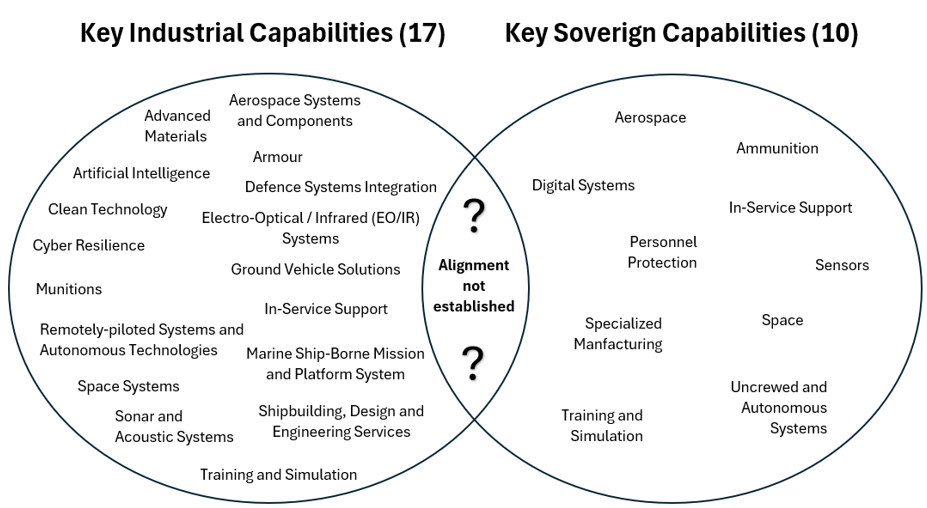
Image description
A two-circle Venn diagram compares “Key Industrial Capabilities (17)” on the left and “Key Sovereign Capabilities (10)” on the right. The overlapping center area marked with a large question mark and the text, “Alignment not established”, indicates that areas of potential overlap are uncertain.
The left circle, Key Industrial Capabilities (KIC)’s consist of 17 items:
- Advanced Materials
- Artificial Intelligence
- Clean Technology
- Cyber Resilience
- Munitions
- Remotely-piloted Systems and Autonomous Technologies
- Space Systems
- Sonar and Acoustic Systems
- Training and Simulation
- Aerospace Systems and Components
- Armour
- Defence Systems Integration
- Electro-Optical / Infrared (EO/IR) Systems
- Ground Vehicle Solutions
- In-Service Support
- Marine Ship-Borne Mission and Platform System
- Shipbuilding, Design and Engineering Services
The right circle, Key Sovereign Capabilities (KSCs) consist of 10 items:
- Aerospace
- Ammunition
- Digital Systems
- In-Service Support
- Personnel Protection
- Sensors
- Space
- Specialized Manufacturing
- Training and Simulation
- Uncrewed and Autonomous Systems
Advancing industry collaboration and a transparent procurement pipeline
A consistent theme highlighted across defence expert interviews was concern about limited and ineffective industry engagement in defence procurement. Interviewees pointed to persistent gaps in engagement and transparency with industry, noting industry lacks the basic information and data needed to effectively plan, invest, and innovate. While forums such as the Defence Industry Advisory Group (DIAG) provide regular dialogue, they were viewed as insufficient for meaningful problem‑solving between government and industry.
The establishment of the DIA and release of the DIS underscore the need for closer collaboration with industry as a strategic partner in achieving Canada’s defence ambitions.
This section examines opportunities to strengthen collaboration and relationships with industry in defence procurement. It provides an overview of the defence industrial base and analyzes key challenge areas identified through expert interviews, including the procurement pipeline, strategic suppliers, the innovation “valley of death,” and early industry engagement.
Canada’s Defence Industry
According to data from ISED’s 2024 Report on Canada’s Defence Industry, based on 2022 figures, Canda’s defence sector is made up of approximately 585 suppliers, with small and medium‑sized enterprises (SMEs) (i.e. fewer than 250 employees) representing 86% of the entire industry.Footnote 112 However, Canada’s defence SMEs only accounted for 19% of revenues, indicating SMEs primarily participate in the defence sector as suppliers to larger companies in supply chains.Footnote 112
Comparing with other jurisdictions, there is no direct comparison that can be made across countries, as each defines and measures its defence industrial base differently. For example, Australia’s defence industry comprised approximately 5,165 businesses in 2024-25, while France’s Ministry of the Armed Forces reported 4,485 companies in 2025. The U.K. defence sector is supported by a large and complex supply chain spanning thousands of firms across multiple sectors, though its full extent is difficult to quantify and not available publicly. The U.S. defence industrial base has several tens of thousands of defence suppliers. General evidence suggests each of these countries’ defence industries is dominated by SMEs to differing degrees.Footnote 113
Canada’s defence sector includes a small number of large companies that account for the majority of revenues (69%), many of which are subsidiaries of major foreign defence contractors.Footnote 114 Canada does not mandate public reporting of defence revenues for private companies or subsidiaries of multinational companies, making it difficult to determine the relative position of larger companies within Canada’s defence sector.
A key characteristic of the Canadian defence industry is the high level of integration with the U.S. industry through defence supply chains that make up Canada’s defence industrial base. A high volume of defence trade occurs at subcontracting levels, making the extent of these ties challenging to measure. In 2022, Canadian defence industry exported over $7B in goods and services, which included 63% of exports to the U.S. as the largest trading partner, 11% to Europe, 6% to Asia and Oceania and 5% to the U.K.Footnote 115
Canada’s defence industrial base is also highly innovative with 31% of the defence industry workforce employed in science, technology, engineering and mathematics (STEM) fields.Footnote 116 Additionally, SMEs account for 23% of total research and development activity within the defence industry, indicating a strong organic innovation capacity among its smaller businesses. This strength should be nurtured, as it is key to driving rapid innovation that large suppliers are unable to match, strengthening supply chains through insertion of advanced technological solutions, and reducing dependence on foreign suppliers.
Canada also has 2 main industry associations representing defence and security suppliers, whose roles are particularly important given sector’s large SME base:
- Canadian Association of Defence and Security Industries (CADSI), founded in 1983, represents a national voice for Canada’s defence industrial base for hundreds of defence, security, and emerging-technology companies.Footnote 117
- Aerospace Industries Association of Canada (AIAC), established in 1962, represents the voice of Canada’s aerospace and space sectors, representing a broad network of firms central to defence aviation, advanced manufacturing, and emerging technologies.Footnote 118
CADSI and AIAC provide industry with vital market intelligence, advocacy, and business development support, and convene key events such as CANSEC (CADSI), and the Canadian Aerospace Summit (AIAC). They also create structured channels for engagement with government stakeholders, such as DND, PSPC, ISED and the DIA, giving industry early insight into capability needs and procurement processes and offering government a consolidated view of industrial capacity and competitiveness.
Defence procurement pipeline for major projects
Consideration 9: Canada could consider, in consultation with industry, publishing and maintaining a transparent defence procurement pipeline that provides forward visibility on near, medium and longer-term requirements to support industry investment, partnering, capacity planning, and to help maximize competition and value for Canada.
Canada lacks a transparent, predictable defence procurement pipeline that provides industry with a long‑term view of military requirements. A credible pipeline would be a forward‑looking, regularly updated roadmap of planned acquisitions, sustainment activities, and major capability investments, enabling industry to anticipate demand, plan production, invest in R&D, and build partnerships with confidence.
Industry has repeatedly emphasized the need for improved procurement visibility, including a single, authoritative source to track Canada’s full defence procurement program of record. Feedback received by OPO from a large Canadian defence supplier underscored that early insight into government decisions is essential to enable timely production planning, technology investment, and supply‑chain development, including partnerships with SMEs and Indigenous businesses.Footnote 119
Existing tools offer only partial solutions. DND’s Defence Capabilities Blueprint provides high‑level information on select projects but lacks sufficient detail, procurement timelines, and regular updates.Footnote 120 CADSI’s annual CAF Outlooks event offers more detailed briefings, though is not government‑led and is accessible only to members and attendees, limiting broader visibility.Footnote 121
Experts consulted by OPO consistently noted that current tools do not provide the level of insight required for effective industry planning and reported that the Defence Capabilities Blueprint is out of date, and that greater transparency on future needs is required.
The 2026 Defence Industrial Strategy acknowledges this gap and commits to establishing a predictable demand signal through measures such as a Defence Advisory Forum, enhanced industry engagement, and a published procurement pipeline.Footnote 122 However, critical details remain to be clarified, including ownership, scope, update frequency, and whether the pipeline will meet industry expectations. Building trust with industry is essential for businesses of all sizes, as small, medium, and large firms will all require clarity to determine where they fit within defence procurement supply chains. The starting points are transparency and follow-through. If projects are identified but fail to materialize, trust will quickly erode. Maintaining an accurate and up-to-date procurement pipeline as projects progress or slow will also require a sustained focus.
As Canada enters a period of unprecedented defence procurement, existing mechanisms are insufficient substitutes for a clear, reliable, publicly accessible, and regularly updated national defence procurement pipeline. Establishing and maintaining such a pipeline will be essential to enabling industry delivery of capabilities required by the Canadian Armed Forces.
Strategic suppliers
Consideration 10: Canada could consider establishing a fair, open, and transparent framework for administering the inclusion, management and removal of strategic suppliers from a living list, supported by clear criteria for inclusion and removal, defined performance expectations, and oversight through Vendor Performance Management (VPM) to ensure accountability and effective delivery. Suppliers could be added to or removed from the list over time based on performance, changing market conditions, or evolving defence priorities.
Recent Development: This section of the report and the associated consideration were developed by OPO prior to the Government of Canada’s May 27, 2026 announcement of a new Strategic Partnership Framework.Footnote 88 For clarity, this section does not include an analysis of the newly released framework. Rather, it identifies areas for Canada to fully consider in the establishment and implementation of the framework, particularly as they relate to the selection of suppliers and the promotion of fairness, openness, and transparency in procurement processes.
One of the new approaches set out by Canada in the DIS is the government’s plan to select key strategic suppliers to help grow Canada’s defence industrial base. Under this approach, Canada will work closely with certain firms, or “Canadian champions,” to build globally competitive companies that can meet domestic needs, secure critical intellectual property and capabilities, and support broader geopolitical and economic objectives, including job creation and stronger industrial capacity.Footnote 87
Strategic suppliers will benefit from advantages such as directed procurement, funding for R&D, support for capital expenditures, export promotion, in-kind contributions, joint development activities and access to research and testing infrastructure. In turn, they will be expected to deliver capability on time and on budget and support national sovereignty through their Canadian supply chains, while also ensuring continued value for money.Footnote 87
These relationships are intended to enhance and protect sovereign capability through mechanisms such as stable funding, longer-term-planning and contracts, and requirements related to surge capacity and readiness. The DIS indicates the Government will publish a framework for the identification and onboarding of select Canadian defence firms as key strategic partners, no later than summer 2026 as an initial step.Footnote 109
In expert interviews conducted by OPO, several interviewees mentioned that Canada may benefit from establishing strategic suppliers as part of the solution to addressing Canada’s persistent defence procurement challenges. It was emphasized that Canada has long needed a new kind of long‑term, partnership‑based relationship with industry, one that provides firms with clear, reliable and sustained visibility into future defence requirements. Ideally, this would include a long-term (e.g. 20‑year) outlook on major capability needs, enabling companies to make timely investments, scale production capacity, and build the workforce and infrastructure required to support the Canadian Armed Forces.
Many of Canada’s allies already operate with some form of strategic supplier model.
France
On the more structured end of the spectrum, France’s defence industrial base is designed around approximately 9 major industrial prime contractors, which act as system integrators within a broader ecosystem of over 4,000 suppliers. Rather than treating prime contractors as interchangeable bidders, France positions a small number of key firms as long-term partners, closely integrated into defence planning and industrial policy, and central to sustaining national capability and strategic autonomy.Footnote 123
In this model, these suppliers act as system architects and integrators, structuring the supply chain around them. Access to defence programs is largely mediated through these primes, as lower-tier suppliers and external firms participate primarily via subcontracting arrangements within prime-led programs. These core suppliers play a central in sustaining France’s strategic autonomy and industrial capacity.Footnote 124
France has long taken a strategic approach to developing its defence industrial base by supporting a small number of key domestic suppliers. This approach is associated with strengthened sovereign capabilities and industrial development, while also demonstrating management of trade-offs, including capacity constraints, supply chain vulnerabilities, and challenges related to European defence integration.Footnote 125
United Kingdom
The U.K. began adopting a strategic partnering approach to defence procurement in the late 1990s, following the 1998 Strategic Defence Review, which introduced a “partnering” model between the Ministry of Defence and industry through Smart Procurement reforms.Footnote 126
This model supports long-term supplier relationships to improve performance and manage risk, but with any strategic supplier approach, it can reduce competition and increase supplier dependence. The U.K.’s Single Source Contract Regulations ensure that non‑competitive defence contracts are fair, transparent, and deliver value for money.Footnote 127
By contrast, Canada’s defence procurement system is more explicitly oriented toward open competition and project-based contracting, with industrial outcomes pursued through mechanisms such as the Industrial and Technological Benefits (ITB) Policy. While these mechanisms aim to generate domestic economic benefits, they do not establish the same degree of sustained, program-centric relationships with a defined set of prime contractors, nor do they embed firms as core partners in long-term capability development and defence planning.
The U.K. and France offer useful models for countries like Canada exploring more structured, long‑term industrial partnerships, highlighting both the benefits of closer supplier relationships and the need to manage risks around competition and dependence.
Office of the Procurement Ombud observations on Canada’s proposed strategic supplier approach
As Canada explores adopting a strategic supplier approach, several core issues must be addressed. Canada will need to clearly define what qualifies an entity as a strategic supplier, how many will be selected, what obligations they must meet, how performance will be assessed, what benefits the designation involves, and what risks and implementation challenges must be managed.
Clear criteria will be needed to determine what qualifies a supplier as a “Canadian champion,” including factors such as incorporation, ownership and control, the location of high-value and other activities (e.g., R&D and sustainment), and the extent to which supply chains are anchored in Canada. Maintaining this status will require ongoing conditions and oversight, recognizing that ownership, operations, and supply chains can evolve over time.
Given that strategic suppliers may also serve commercial markets and allied demand, Canada will need to ensure concrete enforceable measures are in place to secure priority of supply, particularly in crises. Additionally, the CAF must play a central role in selecting and evaluating strategic suppliers to ensure defence spending remains tightly linked to operational needs. Moreover, reduced competition increases the need for rigorous cost‑assurance tools to ensure Canada receives value for money and does not overpay under sole‑source or limited‑competition arrangements.
Strong transparency and oversight mechanisms will be essential, as more work directed to large primes risks reducing visibility, limiting SME access, and concentrating decision‑making power within a few firms. Canada must also guard against over‑reliance on these suppliers, avoiding vendor lock, and ensuring flexibility to adopt new technologies and bring in new entrants when needed.
As contracts are directed to strategic suppliers, clear and enforceable contracts terms and effective contract administration become critical mechanisms to ensure Canada obtains value for money, since competitive tension of solicitation processes will not be available to the government. In addition to delivering the right equipment on time and on budget for the CAF, strategic suppliers will be required to deliver Indigenous business commitments, Industrial and Technological Benefits obligations, and support for Canadian SMEs. This reinforces the need for strong contract administration processes and a robust Vendor Performance Management system to deter and correct poor performance where front-end leverage is limited.
This underscores the importance of the process used to select strategic suppliers. Canada must ensure that the selection of its Canadian champions is conducted through an open, fair, and transparent process, while also providing periodic opportunities to consider new suppliers for inclusion as capabilities and market conditions evolve. Equally important is the establishment of clearly defined off‑ramps for poor performance, supported by a fair and transparent Vendor Performance Management (VPM) process that governs both continued participation and removal. Together, these elements help ensure accountability, maintain competitive tension, and support strong performance outcomes. Failure to do this well risks entrenching closed supplier ecosystems, weakening accountability for performance, and reducing competitive tension. Over time, this could limit innovation, degrade value for money, and undermine the effectiveness and credibility of defence procurement outcomes. Getting this right is therefore critical to achieving intended defence and industrial outcomes.
The innovation “Valley of Death”
Consideration 11: Canada could consider reviewing procurement processes for acquiring government-funded innovations to improve timeliness and efficiency through adjustments to delegated authorities, procurement methods, and pathways to acquisition. Canada could also consider developing a comprehensive mapping of Canadian supplier capabilities, including emerging and dual-use technologies, to aid in assessing alignment with CAF requirements and informing procurement processes.
Protecting and growing Canadian defence innovation is essential to maintaining technological competitiveness especially given the sector’s reliance on SMEs. While the Defence Industrial Strategy recognizes the importance of SMEs in driving innovation, investing in emerging technologies, and safeguarding Canadian intellectual property, it offers limited clarity on how these innovations will be rapidly procured and integrated to support CAF capabilities.
This gap reflects a long‑standing challenge commonly referred to as the innovation “valley of death,” illustrated conceptually in Figure 5 below, where promising technologies fail to transition from early‑stage research and prototyping into operational procurement.Footnote 128 This gap persists for several reasons, including the absence of sustained funding beyond initial development, unclear procurement pathways for adoption by the CAF, and procurement processes and timelines that are misaligned with the speed and risk of technological innovation.
Resolving this issue matters, as failure to do so risks undermining Canada’s ability to translate innovation investments into operational capability, weakening technological competitiveness, and allowing high-potential Canadian innovations to be lost, delayed, or captured by foreign competitors.
DND’s Innovation for Defence Excellence and Security (IDEaS) program funds defence innovation through supplier challenges, advancing successful ideas in phases up to $6.75 million.Footnote 129 Once this threshold is reached, any further research, prototyping, or follow‑on production must proceed through a PSPC‑led competitive procurement process, which can take over one year to complete.Footnote 128 This is because follow-on procurements are generally subject to standard international trade agreement obligations requiring non-discriminatory competition, and therefore cannot rely on the same exclusions or exceptions that permit research and development (R&D) contracts, grants, and innovation testing activities to limit participation to Canadian entities.Footnote 130 This transition from R&D to procurement often represents a critical inflection point where momentum is lost, financial gaps emerge, and technologies stall or halt before reaching operational use.
This approach is not aligned to the high-risk, iterative nature of procuring R&D innovations, nor does it support Canada’s goal of accelerating defence procurement and delivering capabilities to the CAF. Many early-stage innovations do not progress to operational deployment, and SMEs in particular face disproportionate strain, as they often lack the financial resilience to endure long development cycles and procurement delays. As a result, viable innovations may be abandoned or procured by foreign organizations, while delays increase the risk that Canadian firms will be outpaced in rapidly evolving technology areas.
Beyond IDEaS, Canada offers a wide range of programs to support R&D, innovation, and business growth in the defence sector. These include ISED’s Innovative Solutions Canada (ISC),Footnote 131 the National Research Council’s Industrial Research Assistance Program (IRAP),Footnote 132 as well as defence‑specific initiatives, such as ISED’s Regional Defence Investment Initiative (RDII),Footnote 133 and the Business Development Bank of Canada’s (BDC) Defence Platform.Footnote 134
More recently, additional domestic and international mechanisms have been launched, including DND’s Canadian Defence Industry Resilience (CDIR) program,Footnote 135 which supports production capacity, and the Canadian-led multinational Defence, Security and Resilience Bank (DSRB) established with allies to mobilize long‑term private capital across allied supply chains.Footnote 136
Broadly, Canada's innovation ecosystem includes more than 130 federal programs to drive help innovation and growth. While this breadth drives research excellence it can also be complex to navigate, making it harder for innovators to find the right pathway and for defence and security organizations, including DND and the CAF, to access emerging capabilities.Footnote 137
What we heard from defence procurement experts on defence innovation and procurement
Interviewees highlighted persistent structural challenges in bridging innovation and procurement, noting that promising technologies are often unable to transition into defence programs due to weak pathways, lengthy timelines, and gaps in alignment between innovation funding and procurement processes, particularly for SMEs.
- The “valley of death” gap between innovation and procurement: Despite DND investments in early-stage innovation through the IDEaS program, many promising technologies fail to transition into CAF programs due to a lack of sustained funding, unclear adoption pathways to procurement and lengthy procurement timelines.
- The “valley of death” is expanding: As Canada increases the number of innovation funding programs, many more “orphan” products and services will fail to reach procurement.
- Lengthy competitive procurement processes that follow government-funded innovation: Lengthy competitive processes delay adoption of government-funded technologies, or they never get purchased. Competitively procuring a unique innovation that Canada funded doesn’t make sense.
- SME access to procurement: SMEs often cannot absorb the financial strain associated with the long timelines required for Canada to procure products emerging from government-funded R&D.
- Mature system purchases offer limited opportunities for Canadian suppliers: Acquisitions of mature platforms, (e.g., C-130s, F-35s, CC-295s) provide limited opportunities for Canada to integrate innovative products or services developed through IDEaS or other funding programs, into established supply chains.
- Domestic procurement gap limits exports: Without Canadian procurement, suppliers struggle to secure foreign contracts, as foreign buyers look for domestic sales as proof of capability.
- Limited early commitments from foreign bidders: Canada does not consistently secure early commitments from foreign suppliers to integrate Canadian technologies into supply chains.
Office of the Procurement Ombud observations on defence innovation and procurement
It is clear that planned, increased government investment in defence innovation will not deliver results unless promising technologies can move efficiently from development to procurement. Many technologies developed through R&D programs, including IDEaS and other funding initiatives, must transition into contracts, including integration in supply chains for major equipment purchases, including those overseen by the Defence Investment Agency (DIA). Achieving this transition will require coordinated oversight among industry, project teams, and procurement organizations to ensure emerging technologies are procured and integrated into contracts in a timely manner.
The 2026 Defence Industrial Strategy states that the DIA will take on a leadership role in strengthening innovative procurement pathways within programs such as IDEaS and Innovative Solutions Canada (ISC), with the goal of enabling the CAF to more rapidly acquire Canadian-developed defence technologies.Footnote 138 However, the Strategy does not specify how DIA will operationalize this role or to what extent they will address the procurement pathway issue. Moreover, the DIA’s mandate currently focuses on large-scale procurements exceeding $100 million, making it unclear whether PSPC Procurement Branch (PB) will continue to lead all or some R&D procurements, and how responsibilities will be divided between PSPC PB and the DIA.
Similar to the issue of industry lacking visibility into the CAF’s procurement pipeline, as discussed above in relation to Consideration 9, the CAF likely also lacks a comprehensive view of Canadian industry capabilities and how they could be leveraged to meet CAF requirements. A focused effort to map Canadian capabilities—including emerging technologies supported through existing government programs, as well as potential dual-use technologies, products, and services—would help determine alignment with current and future CAF requirements and support a more effective transition from innovation to procurement. A Canadian capability map would also enable Canada to monitor how suppliers respond and adapt to procurement decisions, such as publishing a transparent procurement pipeline (discussed above), or decisions to sole source requirements. This insight would help ensure that procurement practices continue to support a competitive, thriving and innovative defence industrial base, strengthening both industry vitality and CAF capability.
The issue of impractical delegated authorities outlined in Consideration 3 above also applies to R&D, particularly affecting Defence Research and Development Canada within DND, as well as PSPC. Current delegated authorities often lack the flexibility required to advance contracts or contractual arrangements in a timely manner, leading to delays and complicating collaboration with trusted allies. A review of delegated authorities for defence R&D is therefore essential to support Canada’s expanding innovation ambitions and ensure alignment with the expectations of these roles.
Procurement by a domestic government is often an important factor in enabling companies to sell defence products internationally, as it provides external validation of performance and reliability. In Canada, however, innovative technologies developed domestically have not consistently progressed into government procurement, falling prey to the “valley of death”, or purchased for commercial use or by foreign organizations. The projected increase in defence spending and the release of the DIS present an opportunity to address this gap and position Canadian-developed innovative products for purchase by Canada.
Reviewing procurement rules and pathways for R&D, prototyping and related activities of other jurisdictions could offer some ideas to help address this issue domestically. For instance, the U.S. has a specific authority called Other Transaction Authority (OTA), which gives the U.S. Department of Defense a flexible pathway to issue Other Transactions (OTs) to suppliers for research, prototyping, and follow‑on production. OTs are not contracts and are flexible legally binding instruments that are designed to attract innovators and accelerate technology adoption. This means OTs are exempt from U.S. contracting rules (the Federal Acquisition Regulation (FAR), and the Defence Federal Acquisition Regulation Supplement (DFARS)) and international trade agreements. 1 feature of OTA is it provides the ability to award a sole‑source follow‑on production OT or contract without the need to compete if the original prototype OT was competitively awarded, and the prototype was successfully completed.Footnote 139 This model could be studied and explored in the Canadian context.
Addressing persistent issues with the procurement of defence innovation requires sustained focus and reform. While recent initiatives and the DIS mark an important focus in this area, expanding innovation funding without corresponding improvements to procurement pathways risks worsening the problem rather than resolving it. As defence spending and innovation activity increase, ensuring that acquisition processes are agile, timely, and aligned with the pace of technological change will be critical to preventing promising solutions from stalling and to delivering meaningful outcomes for both the CAF and Canadian industry.
Figure 5—The Innovation “Valley of Death”
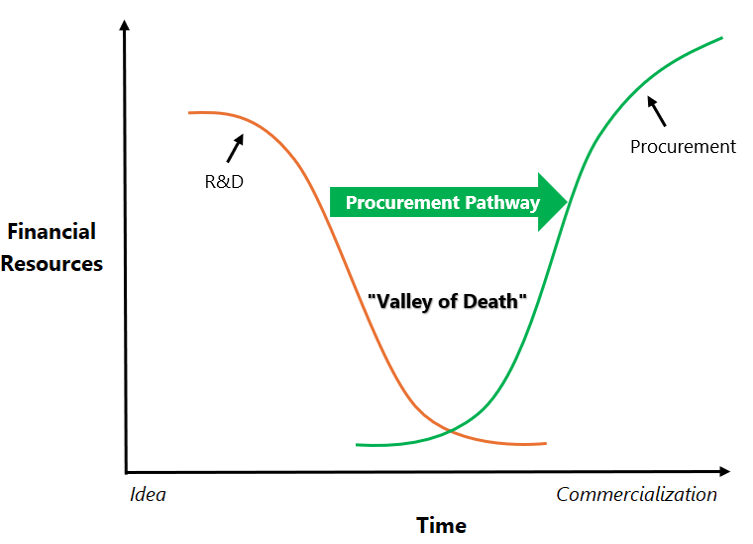
Image description
A line graph titled “The Innovation ‘Valley of Death’” illustrates how funding changes over the lifecycle of an innovation, from early idea to commercialization.
The vertical axis is labeled, “Financial Resources”, and the horizontal axis is labeled, “Time” from “Idea” on the left to “Commercialization” on the right. Two curved lines are drawn on the graph: An “R&D” curve starting high on the “Idea” stage and gradually declining into the “Commercialization” stage, representing an early-stage funding that decreases before products reach maturity. The second, “Procurement” curve starts low at “Idea” and gradually inclines into the “Commercialization” stage, representing financial resources that becomes available later, once solutions that move to procurement become closer to market readiness. An arrow extends between the “R&D” and “Procurement” curves labelled “Procurement Pathway”.
The area under the procurement pathway arrow, and the lowest point where the two curves meet is labeled “Valley of Death.” where both funding sources are minimal. This area highlights a gap where innovations may struggle to secure funding during the transition from R&D procurement.
Early industry engagement in the procurement process
Consideration 12: Canada could consider strengthening how it builds, maintains, and centralizes knowledge of domestic industry capabilities, including those aligned with known and emerging defence requirements, outside of formal procurement processes. This could include developing a mapping of Canadian supplier capabilities to better inform procurement planning and reduce reliance on burdensome RFIs and similar engagement tools. Where RFIs are necessary, Canada could consider narrowing their scope and, where feasible, compensating participating suppliers to mitigate industry burden.
Canada could also expand the use of agile procurement approaches in defence procurement, such as Negotiated Requests for Proposal (NRFPs), to enable structured dialogue, iterative refinement of requirements and bids, and more flexible pathways to acquisition.
Early and sustained industry engagement is essential to ensuring project requirements are “biddable” from a procurement perspective, while maximizing competition and value to Canada. Led by PSPC, industry engagement typically begins during the Options Analysis project phase to inform the development of the procurement strategy and solicitation documents. Canada uses a range of engagement tools, including Requests for Information (RFIs), Invitations to Qualify (ITQs), industry days, site visits, supplier meetings, and in some cases, the release of draft Requests for Proposal (RFP) documents to gather market intelligence, clarify requirements, and inform realistic procurement strategies.Footnote 140 The duration of industry engagement varies by project complexity and market conditions, ranging from several months or years.Footnote 141
While helpful to inform the government, industry engagement activities can place significant burden, cost, and risk on suppliers, as Canada’s defence procurement framework treats these activities as standard business development rather than reimbursable participation.
What we heard from defence procurement experts on industry engagement
Expert feedback raised challenges with the current use of RFIs and early engagement tools. Interviewees pointed to a process that is often inefficient, resource-intensive, and lacking in clarity, with limited follow-through and insufficient alignment between intent and execution.
- RFIs/ITQs issued without follow-through: Procurements often stall for years after RFIs or ITQs due to lack of prioritization or funding, offering limited transparency to industry on whether Canada is ready to proceed.
- RFI overuse creates unrealistic industry expectations: RFIs are widely used to gather market insight, but issuing multiple RFIs on the same requirement can wrongly signal to suppliers that a formal procurement is imminent, even when the Government is only seeking information.
- High burden on suppliers: Responding to RFIs requires significant time and resources, with suppliers often submitting overly detailed or off-scope responses that add burden without corresponding value.
- Suppliers seeking 2-way communication: Suppliers often attempt to use RFIs to seek information and insight into government requirements; however, RFIs are not designed to support 2-way engagement.
- Need for more strategic engagement: More meaningful, strategic engagement with industry is lacking and is necessary to improve transparency and flexibility in the procurement process, rather than relying primarily on issuing RFIs and passively collecting responses from industry.
Office of the Procurement Ombud observations on industry engagement
Expert feedback highlights the need for immediate reform of the RFI process, particularly as Canada seeks to strengthen collaboration and engagement with industry under the new Defence Industrial Strategy.Footnote 122 RFIs in particular are being over‑used, misinterpreted, and often issued without the government being ready to move forward, creating unrealistic expectations and placing unnecessary burdens on industry.
However, deeper issues run beyond the RFI mechanism itself, as heavy reliance on the RFI process as a broad fact‑finding tool signal Canada’s lack of a strong understanding of its own defence industrial base capabilities. As a result, RFIs become a substitute for strategic industrial insight, and the early engagement phase becomes administrative, slow, and frustrating for suppliers. The RFI problem is a symptom of a larger structural issue: “Canada needs to significantly strengthen its understanding of its defence industrial base”. This will help alleviate some need for RFIs, such that they are used strategically and sparingly, rather than as a default tool that fills gaps in internal knowledge. When RFIs are required, Canada could consider the burden on industry to limit scope and compensate suppliers for their responses, to the extent feasible. As discussed above, Consideration 11 suggests Canada could complete a mapping of Canadian supplier capabilities to help inform procurement processes.
The overuse of RFIs also points to another issue: “Canada’s limited use of agile procurement approaches tailored to the nature of what is being acquired”. Agile procurement is a collaborative, outcome-focused approach that brings together government and industry to design procurements iteratively, often through multi-phased processes that allow solutions to be developed, tested, and refined over shorter timeframes.Footnote 142As one interviewee noted, jurisdictions such as the U.S. an U.K. increasingly use agile pathways for major defence procurements, rather than relying on traditional RFPs as the default.
1 practical mechanism aligned with this approach is the use of Negotiated Requests for Proposals (NRFPs). As discussed in the Office of the Procurement Ombud’s 2025 report, Negotiated Requests for Proposal, NRFPs enable structured dialogue between government and qualified suppliers during the procurement process, allowing requirements to be clarified, refined, and improved collaboratively before final bids are submitted.Footnote 143 This makes them well-suited to complex or innovative procurements, where requirements may not be fully defined at the outset and where rigid, 1-step competitive processes can lead to suboptimal outcomes.
In the defence procurement context, including for major projects, NRFPs offer clear advantages over the traditional “1 solicitation, 1 bid” model. They help inform government requirements through iterative engagement, while allowing suppliers to progressively demonstrate how they meet requirements and improve their proposals through dialogue. Executed effectively, this can lead to greater precision, better value for money, and reduced risk for both government and suppliers by minimizing disqualification without the opportunity to correct or strengthen bids. NRFPs also support innovation by enabling suppliers, including SMEs, to shape and demonstrate their solutions, rather than respond to overly prescriptive requirements.
Expanding the use of agile approaches such as NRFPs in defence procurement could improve outcomes and reduce reliance on burdensome RFIs, helping shift away from rigid, one-size-fits-all models toward approaches better suited to the complexity, uncertainty, and pace of defence innovation and the evolving threat environment.
Building professionalization and culture in the defence procurement workforce
Defence procurement workforce professionalization
Consideration 13: Canada could consider establishing a dedicated defence acquisition certification program for personnel involved in the procurement and contract management of major projects to strengthen expertise and retention.
Professionalization of the federal procurement workforce is a long‑standing challenge and remains insufficiently addressed today. This issue is particularly acute in the defence context where the scale, urgency, and complexity of major projects place significantly greater demands on procurement professionals than routine procurements. Despite these demands, there is currently no structured certification pathway for federal procurement professionals working on major defence projects. However, in May 2025, the Comptroller General of Canada introduced a professional development framework for the Government of Canada’s procurement and materiel management communities, which included mandatory measures and publication of procurement career paths, a structured career roadmap, and a proposed curriculum to support procurement practitioners’ progression from junior to senior roles.Footnote 144
Under current Treasury Board of Canada Secretariat (TBS) requirements, procurement professionals must complete 5 mandatory general procurement courses delivered through the Canada School of Public Service (CSPS), totalling approximately 25 hours of mandatory training.Footnote 145 Thereafter, between 21 and 28 hours of annual, procurement learning is suggested for continuous development. Beyond these baseline requirements, there is no formal CSPS learning pathway or certification regime for procurement professionals, nor any education specific to defence procurement or the management of complex, high‑value major projects.Footnote 146.
Importantly, weaknesses in procurement capability for complex contracts have been identified. In 2021, the Auditor General of Canada found that federal organizations undertaking complex procurements, specifically for Information Technology (IT) initiatives, lacked sufficient training, skills, and experience to effectively manage them. The Auditor General concluded that procurement teams rolled out complex and agile procurement approaches without adequate training and recommended that the Government of Canada assess whether procurement officers possessed the skills, competencies, and experience required to manage complex procurements effectively.Footnote 147
This led to TBS updating Procurement Community Competencies in 2024, which identify high‑level knowledge, skills, and behaviours expected of procurement professionals and managers.Footnote 148 However, this framework does not provide a structured certification model, or related curriculum to support progression from junior to senior roles. Moreover, it does not address the specialized demands associated with major defence procurements, including the governance, risk management, and lifecycle oversight of large‑scale and complex programs.
Internationally, there are strong models Canada can look to that provide robust certification and training standards for their workforce, particularly for managing large, complex contracts. The U.S. Department of Defense maintains one of the most structured and legislated professional procurement frameworks in the world under the Defense Acquisition Workforce Improvement Act (DAWIA).Footnote 149 DAWIA mandates certification standards for military and civilian personnel in acquisition positions and is supported by an extensive curriculum delivered through the U.S. Warfighting Acquisition University (formerly the Defense Acquisition University).Footnote 150 This system ensures all personnel, from practitioner through to executive levels, are appropriately trained, qualified, and accountable when managing complex, high‑value defence programs. Additionally, U.S. defence procurement training is closely integrated with the project and acquisition functions, creating strong feedback loops that support continuous improvement of training materials and ensure ongoing relevance for practitioners.
The U.K.’s Defence Academy is another well-established example, operating as a government‑run institution that provides structured, role-based procurement and acquisition training for defence procurement professionals across their careers.Footnote 151 Its integrated training framework equips Ministry of Defence personnel with the process, legislative, contract management, risk, and lifecycle governance expertise required to effectively manage complex defence acquisitions.
A persistent challenge raised by interviewees is high employee turnover in defence procurement, resulting in gaps in expertise and capacity that constrain project advancement and contribute to delays. To address this challenge, and as noted by one interviewee, strengthening the defence acquisition profession through standardized certification, targeted training, and clear career pathways, particularly for complex projects, is necessary. These efforts should be supported by retention measures such as incentives, mentorship, and ongoing professional development to improve workforce stability and business continuity.
The DIA’s CEO indicated in February 2026 that the organization is expected to grow to around 400 personnel at full operational capacity;Footnote 152 however, these preliminary staffing projections appear low given the breadth and complexity of responsibilities envisioned for the DIA in the context of the Defence Industrial Strategy. By comparison, Defence Construction Canada (DCC), a mature federal Crown corporation with a well-defined but comparatively narrower mandate, employs over 1300 full-time equivalent staff and manages an active contract portfolio valued at over $10 billion, according to its 2024-2025 annual report.Footnote 153 DIA’s workforce will require diverse, specialized skills to manage complex procurements, negotiate with industry and allies, and navigate federal project and governance processes.
The need to strengthen, professionalize and retain Canada’s defence procurement workforce has never been more urgent. With unprecedented defence spending, rapidly evolving security demands, and the ambitions of the DIS, program success will depend on whether procurement professionals are equipped to manage complexity and deliver results. Workforce professionalization must be a core component of both the DIS and the DIA’s mandate. Omitting workforce professionalization risks undermining Canada’s defence objectives at the very moment when agility, expertise, and sound judgment are essential. Investing in the people who deliver major defence procurement is a critical enabler of defence readiness. Reforms, tools, and modernized processes cannot succeed without a highly trained and empowered workforce to implement them. As one interviewee put it, without highly trained procurement people in the new context, Canada risks being disadvantaged in domestic and international negotiations.
A culture of risk-aversion
Consideration 14: Canada could consider embedding transparency as a core principle of defence procurement by integrating it more systematically into processes and decision-making. Leveraging transparency in this way strengthens confidence, consistency, and accountability, and supports a cultural shift toward calculated risk-taking, continuous improvement, and excellence.
A 2024 report released by the House of Commons Standing Committee on National Defence (NDDN) identified risk aversion as an issue affecting the efficiency and effectiveness of Canada’s defence procurement processes. One expert witness indicated that this dynamic has “made [federal] public servants very rule- and process-oriented and very risk-averse,” and further suggested that there is a “fear that the slightest error” could embarrass the federal government and become a matter of contentious political debate among legislators and in the media.Footnote 154
A notable number of defence procurement experts interviewed by OPO also raised risk-aversion as a persistent issue plaguing the system. One expert stated that personnel are accustomed to operating within a highly prescriptive rules-based environment, and addressing organizational culture will be necessary to shift away from risk-aversion.
In practice, limited transparency is closely tied to risk‑aversion. Efforts to reduce risk often result in tighter controls, restricted information sharing, and rigid processes. Decision rationales are not consistently documented or communicated, and information is held closely rather than shared. This makes it difficult to clearly identify who is responsible for decisions and on what basis those decisions were made, diffusing accountability across complex processes and governance structures. Over time, this can undermine trust, weaken both individual and organizational accountability, and limit the ability of stakeholders to understand or challenge decisions. It also may reduce opportunities to improve outcomes, as lessons learned are not consistently captured or shared. Rather than reducing risk, these dynamics can narrow options, discourage innovation, and increase operational and reputational risk.
In the defence procurement context, these dynamics are evident in several areas examined in this report. Examples include the limited publication of meaningful information for industry and other stakeholders, such as the absence of a reliable procurement pipeline, inconsistent or inaccessible procurement data, and the lack of a clearly articulated end‑to‑end procurement process. These gaps not only limit transparency, but also make it difficult to track decisions, assess performance, and hold organizations accountable for outcomes. Risk aversion is also reflected in complex and resource‑intensive governance processes, including duplicative elements of the Defence Procurement Strategy (DPS) governance framework, as well as limited delegation of authorities to operational levels. In this environment, accountability can become diffused across multiple layers of oversight, with no single point of ownership for results. Collectively, these practices prioritize risk avoidance over informed, calculated risk‑taking, constraining timeliness, limiting transparency, and reducing opportunities for innovation.
With new reforms and the establishment of the DIA, Canada has an opportunity to move away from risk‑aversion in defence procurement and reframe risk as something to be managed carefully and transparently rather than avoided reflexively. This requires leadership to reward learning over blame, make frameworks and decision rationales visible, and treat calculated experimentation as a core function rather than an exception. Embedding clear feedback loops, proportionate risk‑taking, and accountability for improvement, rather than mere compliance, can shift the culture toward one that values innovation, adaptability, and continuous improvement as safeguards, not threats.
Improving institutional coordination and readiness in defence procurement
Strengthening strategic alignment across defence‑related Crown corporations
Consideration 15: Canada could consider more fully leveraging its Crown corporations to strengthen strategic alignment in support of improved defence procurement outcomes. This could include establishing a coordinated governance model with regular reporting to a central authority, supported by a phased roadmap for delivery. Relevant Crown corporations may include Defence Construction Canada, the Canadian Commercial Corporation, the Business Development Bank of Canada, Export Development Canada, and others.
Multiple Crown corporations support aspects of Canada’s defence procurement system, including infrastructure delivery, export support, financing, and contracting. However, the absence of a coordinated governance model may limit the federal government’s ability to strategically align these capabilities in support of defence procurement objectives.
In light of the Defence Industrial Strategy’s ambitious objectives, such as growing Canadian businesses, jobs, and exports, stronger alignment and coordination across defence-related Crown corporations, each with its own distinct but interconnected mandate, will be critical. A more coordinated governance approach could better align the complementary roles of:
- Defence Construction Canada (DCC) for defence infrastructure delivery;Footnote 57
- Canadian Commercial Corporation (CCC) for government-to-government contracting and defence exports;Footnote 155
- Business Development Bank of Canada (BDC) for financing and growth support to defence suppliers;Footnote 156 and
- Export Development Canada (EDC) for export financing and risk mitigation.Footnote 157
This could include a formal mechanism through which relevant Crown entities regularly convene to align priorities and report to a central authority, improving coherence, reducing duplication, and strengthening accountability. Implementation could be supported through a phased roadmap outlining governance arrangements, roles, key deliverables, and timelines, enabling better outcomes for major defence projects.
Establish an emergency defence procurement capability
Consideration 16: Canada could consider establishing and housing a dedicated defence emergency procurement capability within the Defence Investment Agency, including a standing team and a pre‑defined execution plan with clear rules and processes, to support procurement in response to emergency requirements.
Growing global uncertainty highlights the need for readiness to undertake emergency procurement. Lessons from the COVID-19 pandemic show that preparedness—including dedicated capability, clear governance, and pre‑established rules—is critical to responding effectively to urgent requirements.
Canada could consider strengthening its ability to respond to emergency defence requirements by establishing a dedicated emergency acquisition team within the Defence Investment Agency. This could include a standing, multidisciplinary team supported by pre‑established procurement rules, authorities, and streamlined processes tailored to lead time-sensitive emergency procurement. Formalizing such a capability in advance of crises could improve responsiveness, reduce reliance on ad hoc arrangements, and ensure that speed, oversight, and accountability are appropriately balanced during urgent defence procurements.
The Office of the Procurement Ombud’s 2020 report on Emergency Procurement, highlights best practices that enable rapid response while preserving fairness, transparency, and accountability—lessons that can inform the design of a standing emergency defence acquisition capability today. The following key considerations reflect themes identified in the report.
Emergency procurement—Key considerations
- Advance preparedness: Pre-established emergency contracting authorities, approval thresholds, and guidance to reduce the reliance on ad hoc decision-making under crisis conditions.
- Increased delegation with controls: Temporary increases in contracting and financial authority, paired with defined scope, time limits, and reporting requirements.
- Use of existing instruments: Reliance on standing offers, vendor lists, and options in existing contracts to reduce procurement lead times and improve price and performance certainty.
- Flexible procurement structures: A tailored balance of centralized coordination and decentralized execution, based on the scale and nature of the emergency.
- Fairness and documentation: Continued adherence to principles of fairness, transparency, and thorough documentation to support post-event review and accountability.
- Targeted oversight: Light-touch, risk-based oversight mechanisms (e.g., temporary review committees) for high-risk or non-competitive procurements.
- Supply-chain resilience: Emphasis on supplier diversity, split sourcing, and domestic capacity to mitigate disruptions rather than relying solely on efficiency-driven models.Footnote 158
This emergency procurement capability could be reinforced through regular scenario‑based exercises and wargaming to test authorities, decision‑making, and coordination arrangements, and to ensure readiness prior to an actual emergency.
With this capability in place, Canada would be better positioned to respond rapidly to urgent needs while maintaining fairness, transparency, and public trust, and mitigating risks related to fraud, supply chain disruption, and poor value for money.
Volume 2: Conclusion and considerations
Canada’s defence procurement system has reached a decisive moment. Years of delayed acquisitions, unspent funding, and operational capability gaps for the Canadian Armed Forces have unfolded against a rapidly deteriorating global security environment.
The defence procurement experts interviewed for this report widely agreed that establishing the Defence Investment Agency (DIA) signals a strong commitment to improving the system and represents an important first step toward meaningful reform. At the same time, many expressed concern about the need for greater clarity on how the DIA will function within the broader procurement system. Clear roles, authorities, and decision pathways, paired with early engagement, strengthened industrial insight, and a fully resourced and trained workforce, will be critical to ensuring the DIA can deliver on its ambitious mandate as outlined in the Defence Industrial Strategy.
The risk of inaction now far outweighs the risks associated with doing things differently. Canada’s defence procurement system is in need of long‑overdue, foundational reform, and the conditions for change are finally aligned. The Government has signalled urgency, committed funding, and articulated strategic intent. What is required now is disciplined execution.
As defence procurement reform advances, understanding the challenges of the legacy system is essential to driving meaningful change. Transparency and risk management must be treated as core principles, not afterthoughts. Clearly explaining how and why decisions are made, particularly when new or non‑traditional approaches are used, will be essential to maintaining public trust, sustaining industry confidence, and enabling learning and improvement across the system. A procurement system that is transparent, adaptive, and strategically informed will be better positioned to meet Canada’s defence needs now and into the future.
This report identifies the following 16 considerations as Canada moves toward a new model for defence procurement.
Consideration 1: Canada could consider establishing a clear framework of guiding principles to articulate how technical requirements, economic benefits, cost, and schedule are to be weighed in major defence procurement decisions, including how trade-offs among these elements should be resolved when tensions arise.
Consideration 2: Canada could consider embedding Treasury Board of Canada Secretariat (TBS) personnel within the Department of National Defence (DND) to strengthen early alignment on projects, support teams in anticipating and meeting Treasury Board submission requirements, and streamline the approval process. This potential approach would need to take into consideration the risks related to conflict of interest and blurring of responsibilities between TBS and DND.
Consideration 3: Canada could consider updating departmental authority delegation frameworks to better align authority levels with risk, complexity, commodity and expectations of the position responsible for defence procurement and administration.
Consideration 4: Canada could consider mapping the end-to-end procurement process for major projects and establishing centralized performance data collection to improve transparency and enable evidence-based identification and resolution of inefficiencies and delays.
Consideration 5: Canada could consider strengthening and standardizing transparent contract administration rules and processes, particularly for major defence projects, to better support practitioners in managing post-award delivery risks in high-value, high-complexity contracts. This includes strengthening measures for performance monitoring and intervention, and establishing a single point of accountability for overall delivery of contract outcomes.
Consideration 6: Canada could consider accelerating the implementation of a Vendor Performance Management (VPM) system for defence contracts, particularly major defence contracts, and ensuring its integration into Canada’s new strategic supplier framework.
Consideration 7: Canada could consider undertaking a comprehensive review of the Industrial and Technological Benefits (ITB) Policy to assess its impacts on both economic and defence procurement outcomes, with a view of refocusing it as a strategic, transparent, and enforceable instrument aligned with defence procurement objectives. Integrating contractor performance against ITB obligations into Vendor Performance Management (VPM) would help strengthen accountability and oversight while reinforcing alignment between industrial benefits and procurement outcomes.
Consideration 8: Canada could consider sunsetting the 17 Key Industrial Capabilities (KICs) and replacing them with the 10 Key Sovereign Capabilities (KSCs) to improve clarity and coherence. This list could be maintained as a single, authoritative reference that is reviewed and updated no less frequently than every 3 years to ensure it remains relevant in Canada’s evolving context.
Consideration 9: Canada could consider, in consultation with industry, publishing and maintaining a transparent defence procurement pipeline that provides forward visibility on near, medium and longer-term requirements to support industry investment, partnering, capacity planning, and to help maximize competition and value for Canada.
Consideration 10: Canada could consider establishing a fair, open, and transparent framework for administering the inclusion, management and removal of strategic suppliers from a living list, supported by clear criteria for inclusion and removal, defined performance expectations, and oversight through Vendor Performance Management (VPM) to ensure accountability and effective delivery. Suppliers could be added to or removed from the list over time based on performance, changing market conditions, or evolving defence priorities.
Consideration 11: Canada could consider reviewing procurement processes for acquiring government-funded innovations to improve timeliness and efficiency through adjustments to delegated authorities, procurement methods, and pathways to acquisition. Canada could also consider developing a comprehensive mapping of Canadian supplier capabilities, including emerging and dual-use technologies, to aid in assessing alignment with CAF requirements and informing procurement processes.
Consideration 12: Canada could consider strengthening how it builds, maintains, and centralizes knowledge of domestic industry capabilities, including those aligned with known and emerging defence requirements, outside of formal procurement processes. This could include developing a mapping of Canadian supplier capabilities to better inform procurement planning and reduce reliance on burdensome RFIs and similar engagement tools. Where RFIs are necessary, Canada could consider narrowing their scope and, where feasible, compensating participating suppliers to mitigate industry burden.
Canada could also expand the use of agile procurement approaches in defence procurement, such as Negotiated Requests for Proposal (NRFPs), to enable structured dialogue, iterative refinement of requirements and bids, and more flexible pathways to acquisition.
Consideration 13: Canada could consider establishing a dedicated defence acquisition certification program for personnel involved in the procurement and contract management of major projects to strengthen expertise and retention.
Consideration 14: Canada could consider embedding transparency as a core principle of defence procurement by integrating it more systematically into processes and decision-making. Leveraging transparency in this way strengthens confidence, consistency, and accountability, and supports a cultural shift toward calculated risk-taking, continuous improvement, and excellence.
Consideration 15: Canada could consider more fully leveraging its Crown corporations to strengthen strategic alignment in support of improved defence procurement outcomes. This could include establishing a coordinated governance model with regular reporting to a central authority, supported by a phased roadmap for delivery. Relevant Crown corporations may include Defence Construction Canada, the Canadian Commercial Corporation, the Business Development Bank of Canada, Export Development Canada, and others.
Consideration 16: Canada could consider establishing and housing a dedicated defence emergency procurement capability within the Defence Investment Agency, including a standing team and a pre-defined execution plan with clear rules and processes, to support procurement in response to emergency requirement.
- Date modified: